Singapore Is the World's Most Prepared Urban Society—Here's Why
TL;DR: Singapore combines mandatory civil defence training for all male citizens, a 24-layer community response network, and some of the world's most rigorous building and infrastructure codes to achieve near-zero preventable disaster fatalities in a city of 6 million people.
As of 2024, Singapore's Civil Defence Force (SCDF) reports that more than 1.7 million residents have been trained in Community First Responder (CFR) skills since the programme launched, with the national out-of-hospital cardiac arrest survival rate reaching 40.9%—more than double the global average of roughly 10%—largely because bystanders trained through SCDF's "myResponder" app and community programmes intervene within minutes. That single statistic shows how a structured preparedness culture translates directly into saved lives.
For emergency preppers outside Singapore, the country's approach is not just admirable—it is replicable at the household, neighbourhood, and municipal level.
The Architecture of Singapore's Preparedness System
Mandatory Civil Defence Training
Singapore's National Service (NS) system requires all male citizens to complete military or civil defence training upon turning 18. Under the Civil Defence Volunteer Corps (CDVC), thousands of additional volunteers train alongside full-time SCDF officers in firefighting, urban search and rescue, and hazardous materials response.
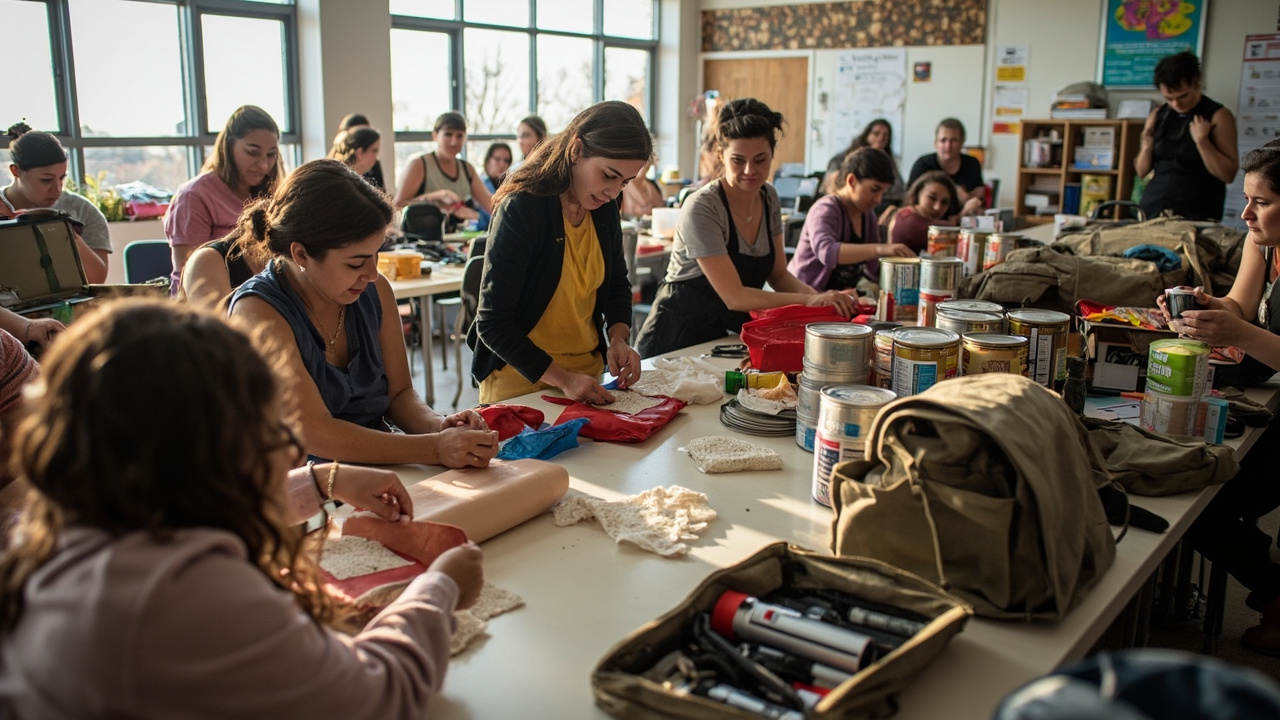
Beyond NS, the Community Emergency Preparedness Programme (CEPP), launched in 2019 and expanded in 2023, offers free public workshops covering fire safety, mass casualty first aid, and crisis communication. According to the SCDF's 2023 Annual Report, over 200,000 residents completed CEPP modules in that year alone—a figure that reflects genuine institutional commitment, not optional checkbox training.
The myResponder Network
The SCDF myResponder app, introduced in 2015 and updated with new cardiac arrest and fire alert features in January 2024, automatically notifies trained CFRs within 400 metres of a reported emergency. As of March 2024, the app has more than 170,000 registered responders across the island. This creates a living, GPS-indexed mesh of first responders who can reach most incidents faster than an ambulance.
The model is directly analogous to a neighbourhood preparedness network that American or European preppers might build through tools like Nextdoor, local CERT (Community Emergency Response Team) programmes, or ham radio nets—but Singapore has made it official, funded, and integrated with dispatch systems.
Urban Planning as Emergency Infrastructure
Shelter-in-Place by Design
Since 1997, Singapore's Building and Construction Authority (BCA) has required every new residential unit to include a Household Shelter (HHS)—a reinforced concrete room rated to withstand blast overpressure. By 2024, approximately 1.2 million HHS units exist across the island according to Singapore's Ministry of Home Affairs, meaning most residents already have a compliant shelter-in-place location without any extra preparation.
Larger Public Shelters (PS) in MRT stations and basements can accommodate tens of thousands of people during a national emergency. These shelters are stocked, ventilated, and inspected on a rolling cycle by the SCDF—not left as hollow concrete rooms.
Water and Food Security Redundancy
Singapore's Four National Taps strategy (local catchment, imported water, NEWater, and desalination) means no single point of failure can cut off the city's water supply. The newest desalination plant, Jurong Island Desalination Plant, came online in 2022 and adds 30 million gallons per day of capacity. The national utility PUB maintains strategic reserves sufficient for months of supply disruption.
For food, the Singapore Food Agency (SFA) runs a "30 by 30" goal—producing 30% of nutritional needs locally by 2030—to reduce import dependency. This is national-level prepping executed as public policy.
Community Networks and Social Cohesion as Preparedness Tools
Singapore's People's Association (PA) manages more than 1,900 grassroots organisations across every residential precinct. These groups are explicitly tasked with community resilience: during COVID-19, they distributed masks and food to vulnerable residents within 48 hours of each new restriction announcement.
The Residents' Committee (RC) and Citizens' Consultative Committee (CCC) structures mean that in any emergency, there is already an organised, trusted local network with contact lists, meeting venues, and communication channels. This is the social infrastructure that FEMA research consistently identifies as the single strongest predictor of community disaster recovery speed.
According to a 2022 study published in the International Journal of Disaster Risk Reduction (Elsevier), communities with pre-existing organised social networks recover from equivalent disasters 30–50% faster than atomised communities—validating Singapore's deliberate investment in civic density.
Lessons Every Prepper and Municipality Can Apply Now
Lesson 1: Train Your Neighbours, Not Just Yourself
Individual stockpiling is far less effective than neighbourhood-level skill distribution. Singapore's data shows that a CFR arriving in under 4 minutes is more valuable than any single household's equipment cache. Organise a local CPR and stop-the-bleed training day through the American Red Cross or your county's CERT chapter. Aim for at least one trained responder per ten households on your street.
Lesson 2: Map Your Local Shelter Inventory
Identify and pre-register at your nearest FEMA-designated shelter and any hardened structures (parking garages, reinforced basements) within a 1-mile radius. Download FEMA's Ready.gov shelter locator and store the addresses offline in case of cellular disruption.
Lesson 3: Eliminate Single Points of Failure in Water
Singapore's four-tap model scales to the household level: maintain a two-week water supply (at minimum 1 gallon per person per day per CDC guidelines), own a gravity water filter (e.g., Berkey or Sawyer), identify a secondary water source (stream, lake, neighbour's well), and know how to purify with household bleach. Redundancy—not volume—is the key principle.
Lesson 4: Build a Communication Mesh Before You Need It
The myResponder app's success depends on pre-registered, geolocated volunteers. Replicate this at neighbourhood scale by establishing a group text chain or mesh radio net (Meshtastic LoRa devices cost under $40 each) with assigned check-in protocols. Run a quarterly drill so the network stays active.
Lesson 5: Integrate Preparedness Into Routine Civic Life
Singapore's secret is that preparedness is not a fringe hobby—it is woven into every building standard, every civic association, and every school curriculum. At the local level, advocate for your city council to adopt NFPA 1600 (the standard on emergency management programmes) and fund annual community drills.
Key Statistics at a Glance
| Metric | Singapore (2024) | Global Average |
|---|---|---|
| Out-of-hospital cardiac arrest survival | 40.9% | ~10% |
| myResponder registered CFRs | 170,000+ | N/A |
| Residential blast shelters | ~1.2 million units | Near zero |
| CEPP graduates (2023 alone) | 200,000+ | N/A |
| Water supply redundancy layers | 4 | 1–2 |
What Singapore Cannot Teach (Honest Limits)
Singapore's model works partly because of scale (a single island city-state), high population density (enabling short CFR response radii), authoritarian enforcement capacity, and extraordinary public funding. Rural American or European communities cannot simply transplant the full system.
The honest takeaway: adopt the principles, adapt the tools. The community CPR mesh, the shelter redundancy, the four-tap water model, and the civic integration of preparedness are all geography-agnostic. The mandatory National Service component is not.
Bottom Line for Preppers
Singapore proves that the most resilient communities are not those with the biggest individual stockpiles—they are the ones where neighbours know each other's skills, every building has a shelter, water has four supply paths, and responder training is treated as a civic norm rather than a hobby. You do not need to live in Singapore to build that culture on your street.
Start this week: schedule a neighbourhood CPR class, identify your two nearest shelters, and add one water redundancy layer. Do all three before the next quarterly drill. That is Singapore's preparedness model distilled to its actionable core.
Sources referenced
- SCDF Community First Responder Programme and myResponder App (https://www.scdf.gov.sg/home/community-volunteers/mobile-apps/myresponder) informed this article's reporting and source checks.
- Singapore Civil Defence Force Annual Report 2023 (https://www.scdf.gov.sg/docs/default-source/scdf-library/annual-reports/scdf-annual-report-2023.pdf) informed this article's reporting and source checks.