The Short Answer: PSCRB Is the Global Standard for Maritime Survival Readiness
The Proficiency in Survival Craft and Rescue Boats (PSCRB) certificate is a non-negotiable credential under the International Convention on Standards of Training, Certification and Watchkeeping for Seafarers (STCW), administered by the International Maritime Organization (IMO). Every officer and rating assigned duties as a member of a survival craft crew must hold it. As of February 2025, Pondicherry Maritime Academy — a Directorate General of Shipping (DGS)-approved institution on the southeast coast of India — is offering fresh cohorts of its five-day PSCRB program, with sessions running daily from 09:00 AM to 05:00 PM.
If you work at sea, plan to work at sea, or are responsible for the safety of people who do, this certification is not optional. What follows is a complete breakdown of what the course covers, who can enroll, what STCW requires, and why hands-on survival training remains one of the highest-value investments any maritime professional can make.
Why PSCRB Exists: The IMO Mandate Behind the Credential
The STCW Convention, first adopted in 1978 and substantially revised in 1995 and 2010 (the Manila Amendments), sets minimum standards for training, certification, and watchkeeping for seafarers worldwide. Regulation VI/2 of the STCW Code specifically mandates that seafarers designated to operate survival craft and rescue boats — other than fast rescue boats — must complete approved proficiency training.
According to the International Maritime Organization's STCW Convention page (https://www.imo.org/en/OurWork/HumanElement/Pages/STCW-Convention.aspx), PSCRB training must cover:
- Types and construction of survival craft and rescue boats
- Equipment carried on survival craft
- Methods of launching and recovery
- Survival at sea, including hypothermia prevention
- Use of pyrotechnics and distress signals
- Helicopter rescue procedures
- Righting of a capsized liferaft
The Manila Amendments of 2010 strengthened enforcement: flag states must verify that certificates issued after January 1, 2012 comply with the updated Code. India's Directorate General of Shipping enforces these requirements domestically, and all DGS-approved institutions — including Pondicherry Maritime Academy — must adhere to the updated STCW 2010 syllabus.
What the Five-Day Course at Pondicherry Maritime Academy Covers
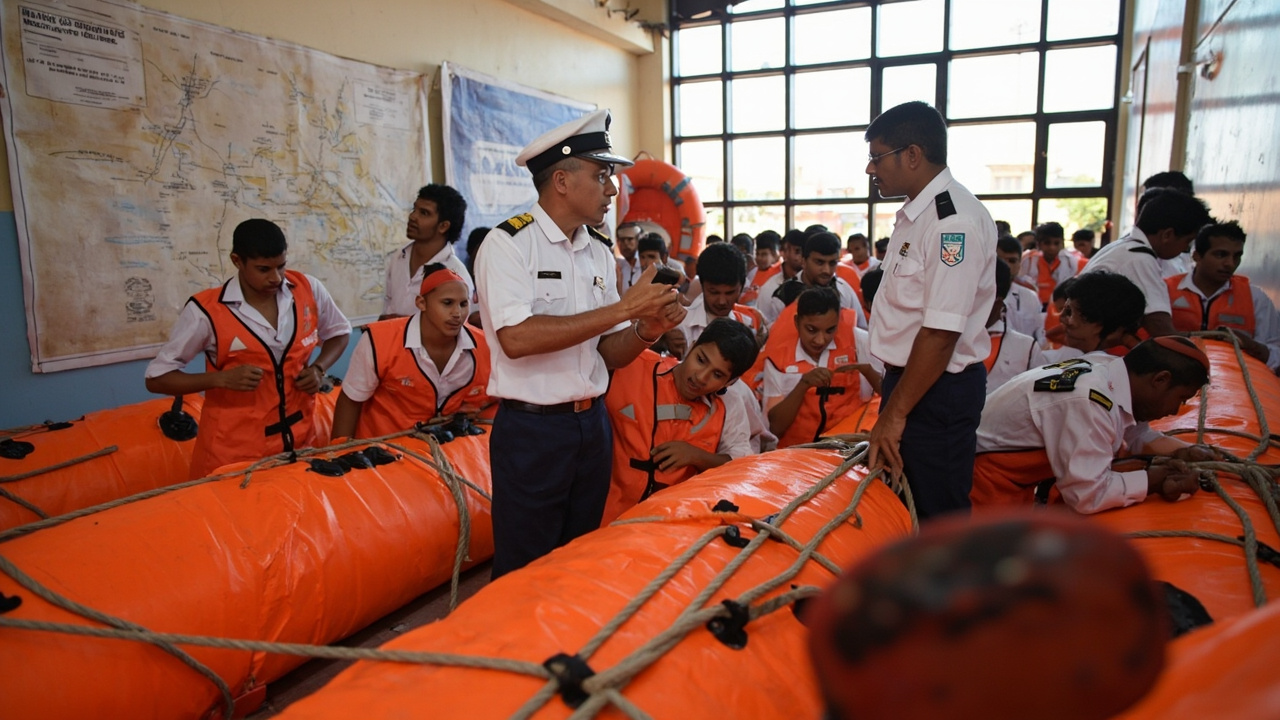
The fresh PSCRB program at Pondicherry Maritime Academy (https://pondicherrymaritime.com/) runs for five full days, with both theoretical instruction and practical, water-based exercises. The academy is DGS-approved and equipped with operational lifeboats and liferafts used in realistic drills.
Day 1–2: Survival Craft Systems and Equipment
Participants learn the construction standards of IMO-compliant lifeboats, rescue boats, and inflatable liferafts. Instructors walk through every item of onboard equipment — from EPIRB (Emergency Position-Indicating Radio Beacon) units to thermal protective aids — explaining both function and correct deployment procedure. This segment directly maps to STCW Table VI/2-1, which lists the minimum standards of competence for survival craft operations.
Day 3: Launching, Recovery, and Boat Handling
This is the hands-on core of the program. Trainees practice davit-launched lifeboat operations, free-fall launches where applicable, and recovery procedures in simulated adverse conditions. The Pondicherry Maritime Academy course listing notes this practical component as mandatory; 100% attendance is required to sit for the final assessment.
Day 4: Sea Survival and Medical First Aid
Day four covers in-water survival: hypothermia management, HELP (Heat Escape Lessening Posture), group huddle techniques, and rationing of emergency water and food supplies. A medical first aid module reviews treatment of immersion injuries, shock, and burns — all common outcomes of maritime casualties. The International Maritime Organization's STCW documentation notes that psychological preparedness and leadership under stress are explicit competency targets at this stage.
Day 5: Distress Signals, Helicopter Rescue, and Assessment
The final day focuses on pyrotechnic devices (flares, smoke signals), SART (Search and Rescue Transponder) operation, and helicopter rescue procedures including correct positioning in the water and signal protocols. A written and practical assessment concludes the course. Successful candidates receive a DGS-endorsed PSCRB certificate valid for five years, after which a one-day Refresher PSCRB (R-PSCRB) course revalidates the credential.
Who Can Enroll: Entry Requirements
The Pondicherry Maritime Academy sets the following prerequisites, consistent with DGS and STCW requirements:
- Sea service: Minimum 12 months of documented sea service, OR a recognized pre-sea training certificate (which typically substitutes for 6 months of sea service).
- Basic Safety Training (BST): A valid STCW Basic Safety Training certificate is mandatory.
- Medical fitness: A valid ENG1 or equivalent seafarer medical certificate.
- E-learning modules: Mandatory pre-course online modules must be completed before the first day of physical attendance. These cover theory fundamentals and allow classroom time to focus on applied skills.
- Attendance: 100% attendance is enforced. Missing a single day invalidates enrollment for that cohort.
As of early 2025, the Directorate General of Shipping has discontinued formal exit examinations for refresher (R-PSCRB) courses, reducing administrative burden for experienced seafarers renewing their credentials — though the full five-day fresh course still carries an end-of-course assessment.
The Refresher Option: R-PSCRB in One Day
Seafarers whose PSCRB certificate is within the revalidation window can complete the R-PSCRB — a single-day refresher offered at Pondicherry Maritime Academy. The condensed program revisits practical skills, updated regulatory requirements, and any equipment changes since the original certification. Given the DGS's removal of formal exit exams for refresher courses, the administrative pathway is now faster, though instructors still evaluate practical competency throughout the day.
Why Survival Training Is Irreplaceable for Emergency Preparedness
Maritime casualties remain a persistent global risk. The European Maritime Safety Agency (EMSA) Annual Overview of Marine Casualties and Incidents consistently documents hundreds of serious shipping incidents each year across European waters alone — and global figures from the IMO are substantially higher when including all flag states.
The core insight from STCW-mandated training is transferable beyond commercial shipping: structured, scenario-based survival drills build procedural memory that holds under cognitive load. Firefighters, EMTs, and military personnel train the same way for the same reason. When a lifeboat must be launched at 3 AM in force-7 seas, the crew that has practiced the sequence dozens of times in a controlled environment makes fewer fatal errors than one relying on written procedures alone.
For individuals entering the maritime industry, PSCRB certification is both a legal prerequisite and a genuine competency. For employers, verifying that crews hold current PSCRB certificates is a Port State Control obligation — ships with uncertified crew face detention.
How to Register at Pondicherry Maritime Academy
Enrollment is handled through the academy's online booking portal at https://pondicherrymaritime.com/. The course listing page provides batch dates, fee structures, and document upload functionality for pre-enrollment verification. Cohorts fill quickly ahead of each start date; the academy recommends booking at least two to three weeks in advance.
Documents to prepare before registration:
- Scanned copy of BST certificate
- Scanned copy of sea service discharge book or pre-sea training certificate
- Valid seafarer medical certificate
- Government-issued photo ID
- Passport-size photographs
For questions not resolved through the portal, the academy's contact details — including phone and email — are listed on the official website under the "Contact Us" section.
Key Regulatory Context: STCW and Indian DGS Alignment
India ratified the STCW Convention and its Manila Amendments; the Directorate General of Shipping issues all seafarer certificates domestically. DGS Circular 14 of 2017 and subsequent amendments standardize the approved syllabus for all STCW short courses, including PSCRB, ensuring that a certificate earned at Pondicherry Maritime Academy carries the same regulatory weight as one earned at any other DGS-approved institution. International recognition follows under STCW's white-list framework — Indian certificates are accepted by virtually all major flag states and port states.
The IMO's STCW Convention page (https://www.imo.org/en/OurWork/HumanElement/Pages/STCW-Convention.aspx) maintains the authoritative text of the Convention and its Code, including the competency tables that define exactly what PSCRB training must achieve.
Bottom Line
PSCRB certification is one of the most directly life-saving credentials available to maritime professionals. The five-day program at Pondicherry Maritime Academy delivers the full STCW-compliant curriculum — lifeboat handling, sea survival, distress signaling, and medical response — in a structured environment with DGS-approved instructors and operational equipment. Whether you are entering the industry for the first time or revalidating an existing certificate, the investment is both legally required and practically essential.