Essential Survival Skills Every Camper Must Master Before Hitting the Trail
TL;DR: Every camper should master seven core wilderness survival skills—water purification, shelter construction, fire-starting, compass navigation, basic first aid, rescue signaling, and edible plant identification—before entering the backcountry, because these abilities directly determine survival outcomes when technology fails and help is hours away.
Every year, search-and-rescue teams respond to thousands of incidents involving unprepared campers. According to the National Park Service, rangers conducted more than 3,200 search-and-rescue operations in 2022 alone, with dehydration, exposure, and getting lost topping the cause list. The good news: the vast majority of these emergencies are survivable—and preventable—with the right skill set. As Bushcraft Base Camp documents in its guide How to Survive a Wilderness Emergency: 7 Essential Skills Every Camper Needs, mastering a handful of core competencies can convert a life-threatening situation into a manageable inconvenience.
This guide breaks down each skill with actionable techniques, gear recommendations, and training resources so you can head into the wilderness with genuine confidence.
1. Finding and Purifying Water
The human body begins to suffer cognitive impairment within two hours of significant dehydration and can die within three days without water. Locating a safe source is therefore your first priority in any survival scenario.
How to find it: Animals and insects are reliable indicators. Birds fly toward water at dawn and dusk; following them often leads to streams or springs. Valleys and low-lying terrain naturally channel runoff. Green vegetation in an otherwise dry landscape often marks a subsurface water source.
How to purify it: Boiling is the gold standard—bring water to a rolling boil for at least one minute (three minutes above 6,500 feet elevation) to kill bacteria, viruses, and protozoa. Chemical treatment with iodine or chlorine dioxide tablets is a compact backup option; follow manufacturer dosing instructions precisely. Portable filter straws such as the LifeStraw remove 99.9999% of bacteria and 99.9% of protozoa, per the manufacturer's independent lab testing.
As detailed in Bushcraft Base Camp's wilderness emergency guide, skipping purification even from a clear-looking mountain stream risks contracting giardia or cryptosporidium, both of which cause severe GI illness that compounds a survival crisis.
2. Building a Weatherproof Shelter
Hypothermia can set in at temperatures as high as 50°F (10°C) when a person is wet and exposed to wind. Shelter is often more urgent than food or even water in cold or wet conditions.
Site selection: Choose elevated ground that drains well. Avoid ridgelines exposed to wind and valley floors prone to cold air pooling. Look for natural windbreaks—boulders, dense shrubs, or a fallen tree trunk.
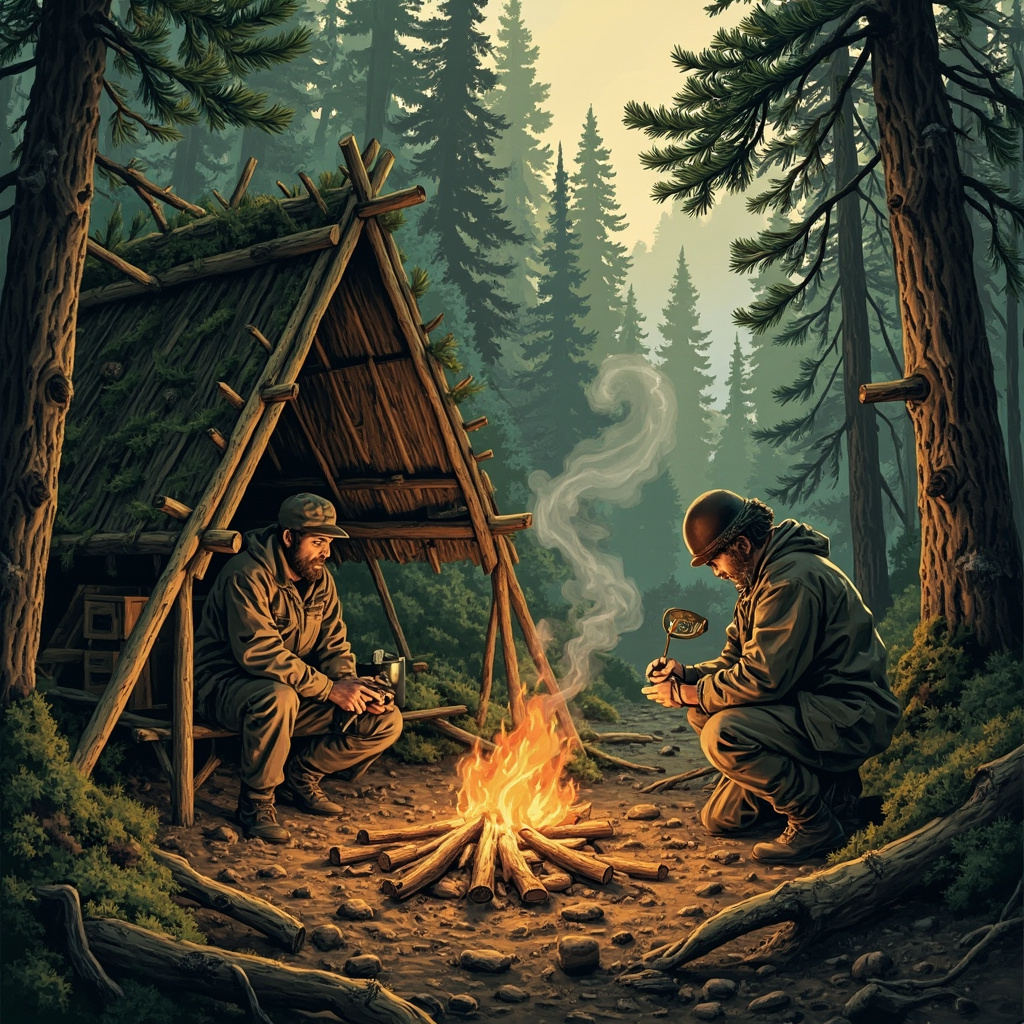
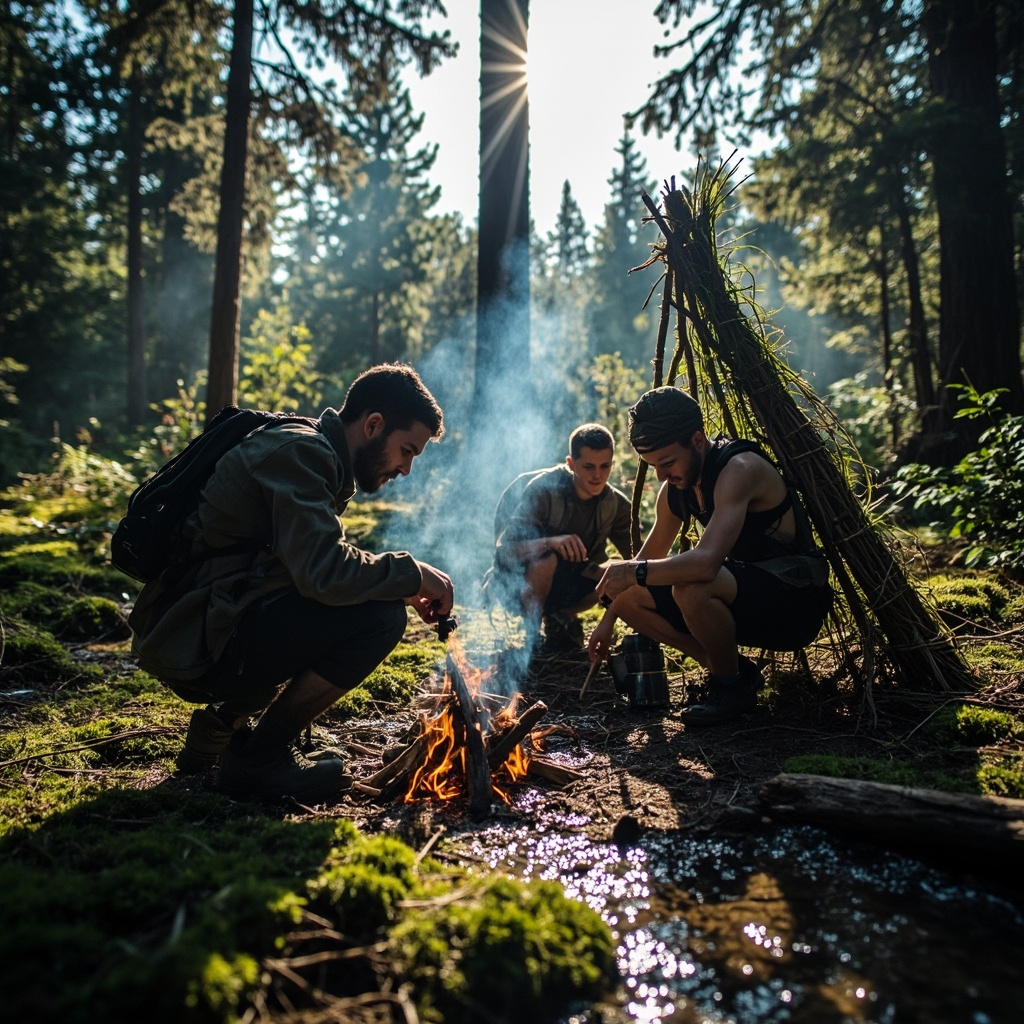
Construction: A debris hut is the most effective no-tool shelter in a forested environment. Lay a ridgepole 9–10 feet long between a forked tree and the ground. Prop ribbing branches along both sides, then pile on 2–3 feet of dry leaves, pine needles, and forest debris. The air pockets trapped in the debris provide insulation equivalent to several blankets. Lashing techniques using paracord or natural cordage (twisted bark fibers, plant stems) keep the frame stable in wind.
3. Starting a Fire Without Matches
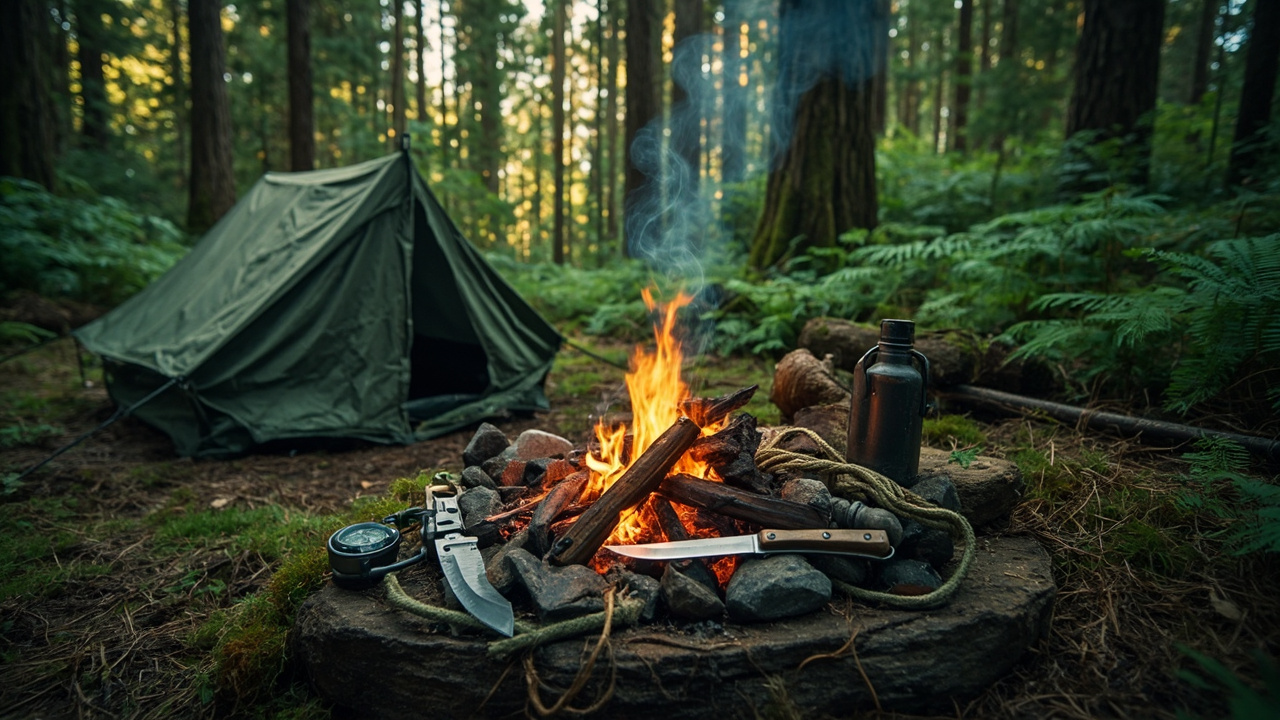
Fire provides warmth, a means to boil water, a cooking platform, and a psychological anchor during a frightening situation. Relying on a lighter alone is risky—lighters fail in wet or cold conditions.
Ferro rod: A ferrocerium rod and steel striker produces sparks at approximately 5,400°F and works when wet. Practice at home until you can produce a flame in under 90 seconds.
Bow drill: The traditional friction method requires a straight, dry spindle, a flat fireboard with a notch, a handhold piece, and a bow strung with cordage. It demands physical effort but requires no purchased equipment. It is worth learning as a backup.
Tinder preparation: Success depends almost entirely on tinder quality. Dry grass, cattail fluff, shredded bark from birch or cedar, and commercial char cloth all catch a spark reliably. Gather and protect your tinder bundle before attempting ignition.
4. Navigating With a Map and Compass
GPS devices fail when batteries die or satellites are obscured by canyon walls. A topographic map and baseplate compass cost under $30 combined and never run out of power.
Key skills to practice:
- Taking a bearing: Align the compass direction-of-travel arrow with your destination on the map, rotate the bezel to match, then follow the needle.
- Accounting for magnetic declination: In 2024, declination in the contiguous United States ranges from roughly +20° (Pacific Northwest) to -20° (Maine). The NOAA National Centers for Environmental Information publishes a free online declination calculator for any location.
- Reading contour lines: Lines spaced closely together indicate steep terrain; widely spaced lines indicate gentle slopes. Contour lines that form a V pointing uphill indicate a valley; V pointing downhill indicates a ridge.
Navigational errors compound quickly. A 5-degree bearing mistake translates to roughly 460 feet of lateral error per mile traveled—enough to miss a trail junction entirely.
5. Performing Basic First Aid
The average emergency medical response time in rural areas in the United States is 18 minutes, according to a 2023 study published in JAMA Network Open. In deep backcountry, it can be hours or days. Knowing how to bridge that gap is non-negotiable.
Essential skills:
- Wound cleaning and closure: Irrigate wounds with clean water, apply antibiotic ointment, and close with butterfly strips or wound closure tape. Do not use sutures unless trained.
- Bleeding control: Apply direct pressure for at least 10 continuous minutes without lifting the dressing. For limb wounds that continue bleeding, a tourniquet (CAT tourniquet or improvised wide-band tourniquet) applied 2–3 inches above the wound can be life-saving.
- Recognizing heat exhaustion vs. heat stroke: Heat exhaustion presents with heavy sweating, pale clammy skin, and weakness; move the patient to shade and hydrate. Heat stroke presents with hot dry skin, confusion, and a body temperature above 104°F—this is a life-threatening emergency requiring rapid cooling and evacuation.
- Frostbite identification: White or grayish-yellow skin that feels hard and waxy. Do not rub frostbitten tissue; rewarm gently in warm (not hot) water only if refreezing is not a risk.
The Wilderness Medical Society offers a two-day Wilderness First Aid (WFA) certification and a week-long Wilderness First Responder (WFR) course—both widely recognized standards for backcountry travelers.
6. Signaling for Rescue
The international distress signal is three of anything repeated at regular intervals: three whistle blasts, three gunshots, three smoke columns, or three mirror flashes. Rescuers are trained to recognize this pattern.
Gear that works:
- Signal mirror: A glass signal mirror visible up to 10 miles in bright sunlight costs under $15 and weighs less than one ounce.
- Emergency whistle: A Fox 40 Pealess whistle produces 115 dB and functions when wet or frozen—far louder and less exhausting than shouting.
- Personal Locator Beacon (PLB): A registered PLB triggers a satellite alert to the nearest rescue coordination center. The ACR ResQLink 400, FAA-certified and float-rated, retails for approximately $300 and requires no subscription fee.
As Bushcraft Base Camp notes in its wilderness emergency guide, combining multiple signal methods—auditory and visual simultaneously—dramatically increases the probability that a search team locates you within the first operational period.
7. Identifying Edible Wild Plants
Humans can survive approximately three weeks without food, but caloric intake supports physical strength and mental acuity during a prolonged situation. Foraging safely requires correct identification—dangerous lookalikes exist for many edible species.
High-confidence beginner species (North America):
- Cattail (Typha latifolia): Found near water; the green flower spike is edible raw or boiled in spring; pollen is a flour substitute.
- Dandelion (Taraxacum officinale): Leaves, flowers, and roots are all edible; leaves are most palatable before flowering.
- Wood sorrel (Oxalis spp.): Heart-shaped clover-like leaves with a tart, lemony flavor; safe in moderate quantities.
The cardinal rule: Never eat anything you cannot identify with 100% certainty from at least two independent field guides. The Audubon Society Field Guides series and Samuel Thayer's The Forager's Harvest are considered authoritative references for North American plant identification.
How to Build These Skills Before Your Trip
Practice is not optional. Reading about a bow drill does not give you the muscle memory to use one under stress. Recommended training pathways:
- Wilderness First Aid (WFA): Two-day course, widely available through NOLS, REI, and SOLO Schools of Wilderness Medicine.
- Land navigation courses: The U.S. Army and many state forestry departments offer public orienteering workshops.
- Survival weekends: Organizations like the Tom Brown Jr. Tracker School in New Jersey and Alderleaf Wilderness College in Washington State run multi-day immersive programs focused on primitive skills.
- Practice at home: Light fires with a ferro rod in your backyard. Build a debris hut in a local park. Run a compass course at an orienteering club meet before you need those skills for real.
Gear without skill is a false safety net. A $500 GPS unit does not help when the battery dies on day three of a five-day trip. These seven skills cost nothing but time to acquire—and they will serve you for life.
Before You Leave the Trailhead
File a detailed trip plan with a trusted person who is not on the trip. Include your planned route, campsites, expected return date and time, and the instruction to call search and rescue if you have not checked in by a specific time. This single action has saved countless lives and costs nothing.
Sources referenced
- National Park Service Search and Rescue Statistics 2022 (https://www.nps.gov/subjects/emergency/search-and-rescue.htm) informed this article's reporting and source checks.