TL;DR: Preppers who depend exclusively on gear, apps, and supply chains are one grid-down event away from helplessness — mastering primitive survival skills like fire-starting, water procurement, shelter construction, and wild foraging is the single most reliable way to stay alive when modern infrastructure collapses.
The sentiment circulating on preparedness social media — "acquire good skills of survival, not dependence on the civilised world" — is not just philosophy. It is operationally sound doctrine backed by decades of wilderness survival research and hard-won lessons from real disasters. When Hurricane Katrina struck New Orleans in August 2005, FEMA's own after-action report documented that residents who could perform basic self-rescue tasks — building improvised shelter, sourcing potable water, navigating without GPS — survived in far greater numbers during the critical 72-hour window before institutional aid arrived. The lesson has not changed: gear fails, batteries die, and supply chains snap. Skills do not.
This article breaks down the five primitive survival skill categories that every prepper should train in now, with sourced guidance on how to develop genuine proficiency — not just theoretical familiarity.
Why Primitive Skills Beat Gear-Dependency Every Time
The U.S. Army Survival Manual (FM 3-05.70), one of the most widely cited field references in the preparedness community, opens with a blunt hierarchy: attitude and knowledge outrank equipment. The manual explicitly states that a person with solid primitive skills and no gear will outlast a person loaded with gadgets but no training. This is not a marginal difference — in a prolonged grid-down scenario lasting more than seven days, gear-dependent preppers face catastrophic failure points the moment a critical item breaks, runs out, or is lost.
The FEMA Individual and Community Preparedness report (updated 2023) similarly found that communities with higher rates of hands-on skills training — not just supply stockpiling — demonstrated measurably faster recovery times after declared disasters. Skills compound; stored goods deplete.
Skill 1: Fire-Starting Without Matches or Lighters
Fire is the master skill. It purifies water, signals rescuers, regulates body temperature, cooks food, and provides psychological stability. Yet most preppers who own ten lighters have never successfully started a fire by friction.
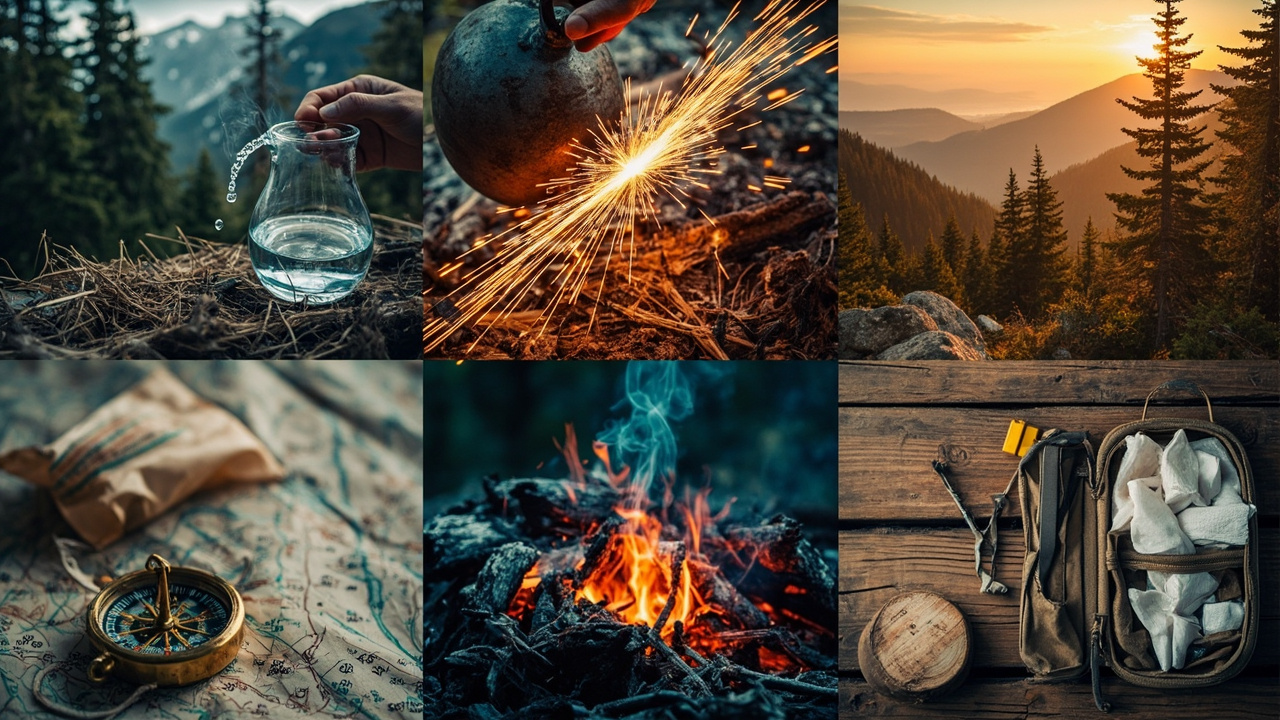
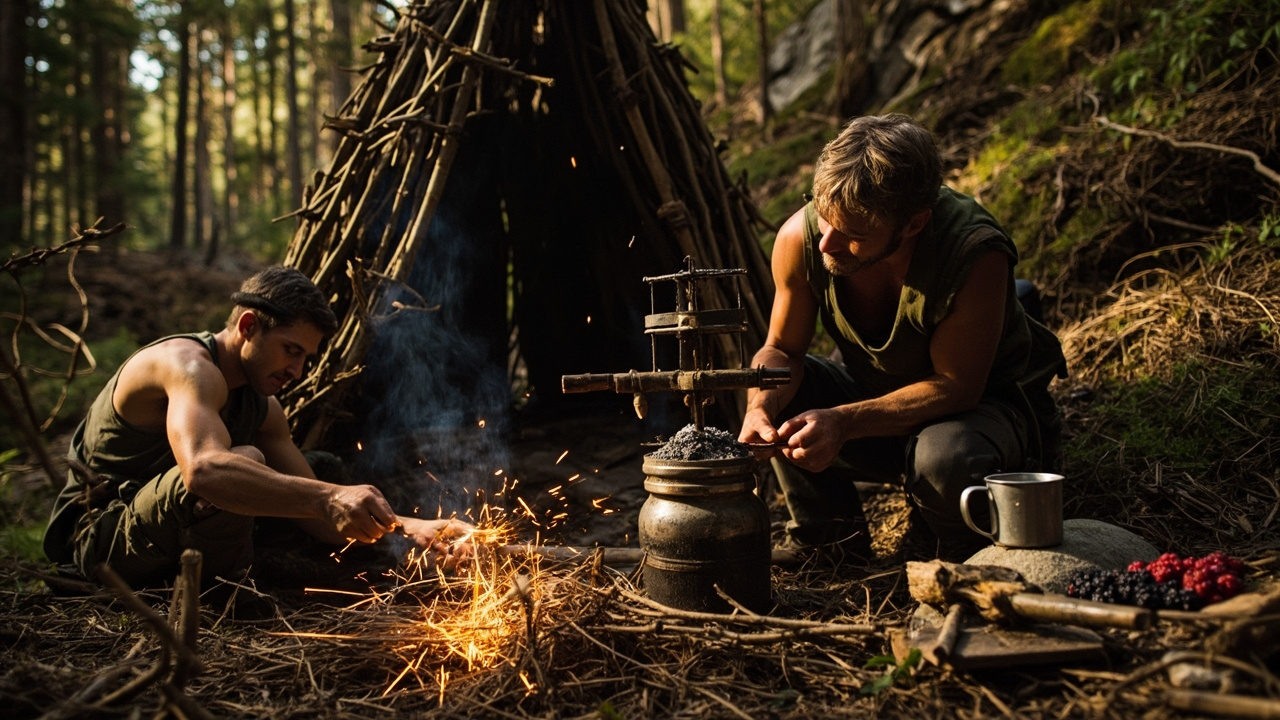
The bow-drill method remains the most teachable friction fire technique for temperate climates. It requires a fireboard (dry softwood like cottonwood, willow, or cedar), a spindle of matching wood, a bow strung with cordage, a handhold, and a tinder bundle. The U.S. Army Survival Manual (FM 3-05.70) dedicates an entire section to friction fire, noting that proper wood selection and moisture content are more critical than technique — wet wood will not ignite regardless of effort.
Practice benchmark: aim to produce a coal within 60 seconds of active drilling. If you cannot, your wood selection or technique needs work. Practice at home before temperatures drop or pressure mounts.
Flint-and-steel and ferro rod striking bridge the gap between primitive and modern. A ferro rod is a legitimate backup tool, but strike-a-light flint kits work indefinitely without manufactured components — a critical advantage in a multi-year infrastructure collapse scenario.
Skill 2: Water Procurement and Purification
Dehydration kills faster than starvation. The human body begins experiencing cognitive impairment after losing just 2% of body weight in water — roughly one liter for an average adult. In a grid-down event, municipal water systems fail within hours of power loss because pumping stations depend on electricity.
Primitive water procurement involves three steps: finding, collecting, and purifying.
- Finding: In most North American and European environments, water follows topography downhill. Animal trails, insect swarms, and lush green vegetation in arid landscapes are reliable indicators of subsurface water.
- Collecting: Solar stills, transpiration bags tied around leafy tree branches, and morning dew collection from non-toxic foliage are low-tech methods documented by the U.S. Army Survival Manual (FM 3-05.70) for producing small but life-sustaining quantities.
- Purifying: Boiling at a rolling boil for one full minute (three minutes above 6,500 feet / 2,000 meters) kills all biological pathogens according to the U.S. Centers for Disease Control and Prevention (CDC). Improvised charcoal-sand-gravel filters remove particulates and improve taste but do not render water microbiologically safe on their own — boiling must follow.
The CDC's Drinking Water Treatment page, last updated in 2023, confirms that boiling is the most universally reliable method available without commercial filtration equipment.
Skill 3: Emergency Shelter Construction
Exposure kills faster than dehydration in cold, wet, or windy environments. The survival rule of threes — widely cited in wilderness medicine — states a person can survive roughly three hours in a harsh environment without shelter. That window shrinks further in rain or wind because wet clothing loses 90% of its insulating value.
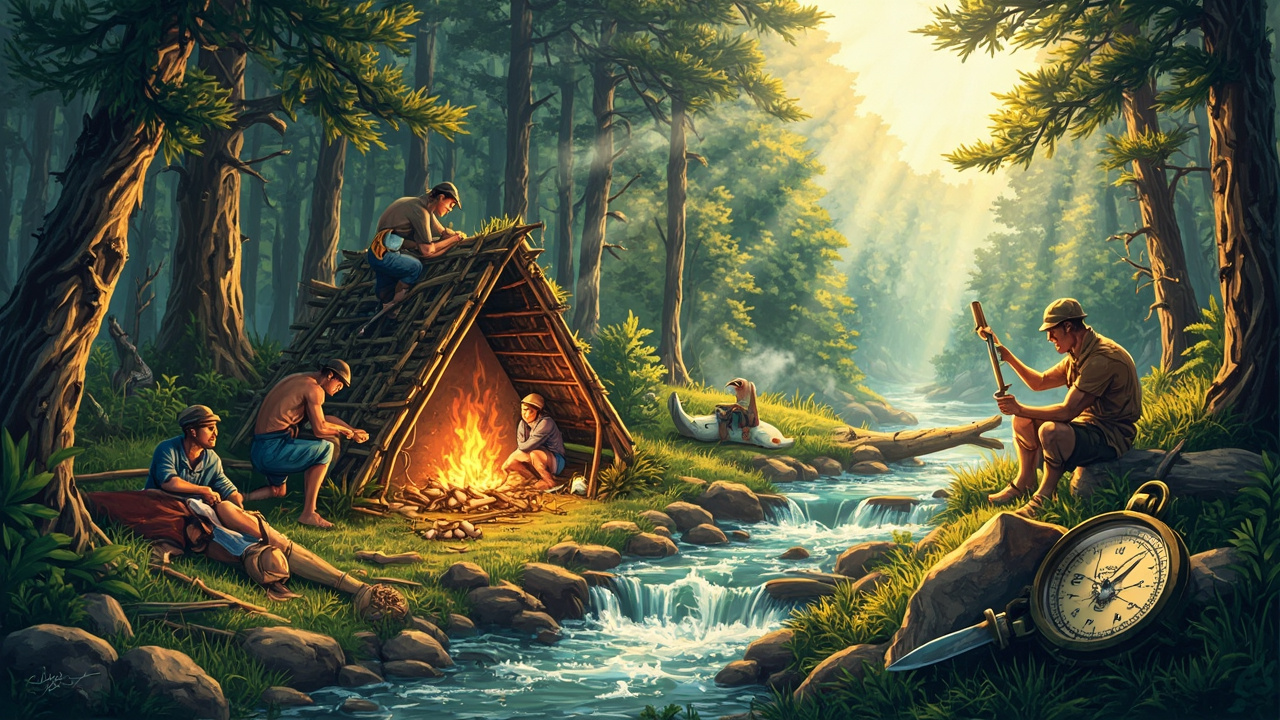
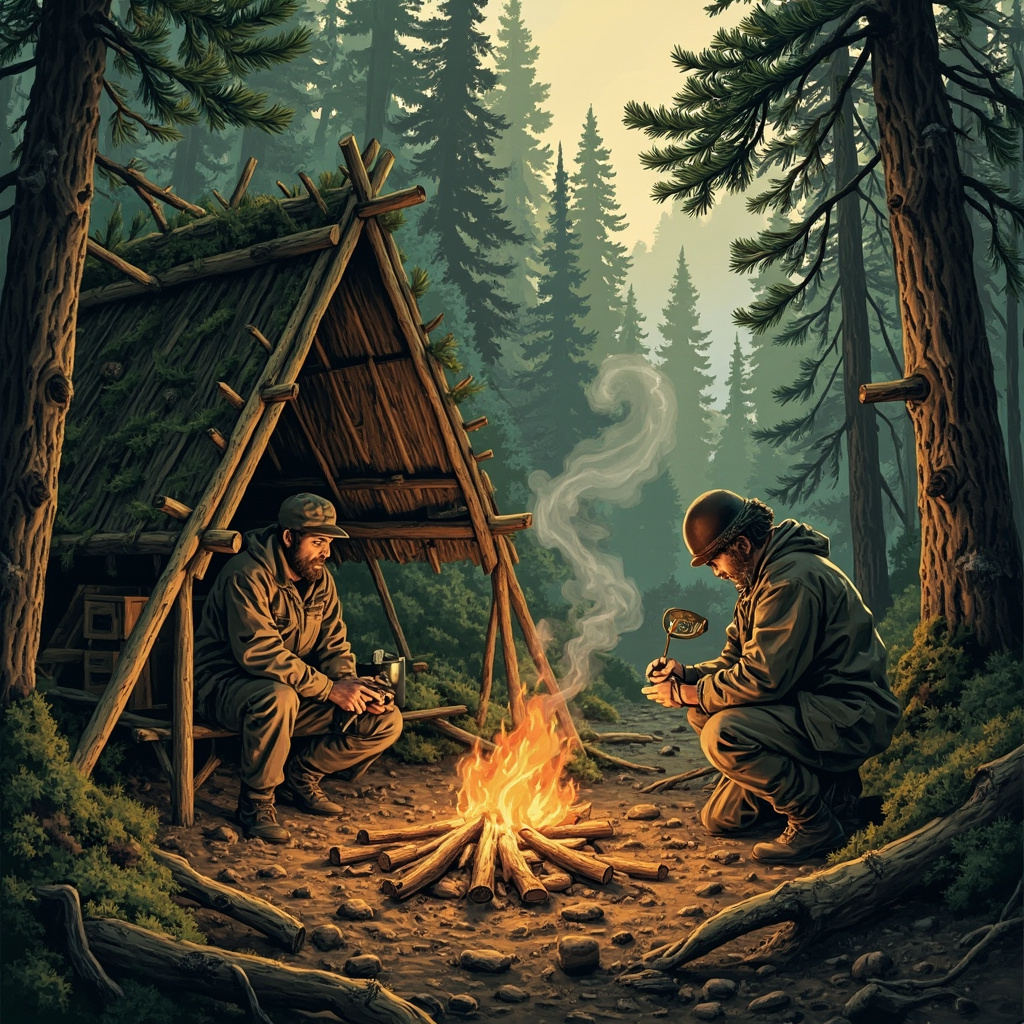
The debris hut is the gold standard primitive shelter. It requires no tools, no cordage, and no manufactured materials. A properly constructed debris hut — with a ridgepole resting between a fork and the ground, ribbed with branches, and covered in two to three feet of loose leaf debris — can maintain interior temperatures 30–40°F (17–22°C) warmer than outside air, even without a fire inside.
Construction fundamentals:
- Site selection away from dead trees, flood channels, and ant hills.
- Ridgepole length approximately equal to the builder's body length plus 18 inches.
- Interior width no wider than shoulder width — tighter is warmer.
- Debris thickness should be arm's-length deep on all sides.
Practice building a debris hut in your backyard before you need it in a forest at 3 a.m. in October.
Skill 4: Wild Food Foraging
The human body can survive approximately three weeks without food, but cognitive function, physical strength, and morale all degrade rapidly after 48–72 hours of caloric deprivation. Foraging is a supplement to stored food, not a replacement — but it can meaningfully extend survival duration.
Start with the easiest, most widespread edibles:
- Cattail (Typha latifolia): Found near water throughout North America and Europe. The pollen spike, green seed head, and inner stalk base are all edible and highly caloric. Identified by Samuel Thayer in Nature's Garden (Forager's Harvest Press, 2010) as one of the most productive wild foods per acre.
- Dandelion (Taraxacum officinale): Leaves, flowers, and roots are edible year-round. No dangerous lookalikes in North America.
- Acorns (Quercus spp.): All oak acorn species are edible after leaching tannins in cold running water or multiple changes of cold water over 12–24 hours.
The critical rule: never eat anything you cannot identify with 100% certainty. Misidentification of toxic plants — particularly members of the carrot family (Apiaceae), which includes water hemlock (Cicuta douglasii), one of North America's most toxic plants — kills experienced and inexperienced foragers alike. Invest in a regionally specific field guide and attend at least one hands-on foraging walk with a certified instructor before relying on the skill.
Skill 5: Navigation Without Electronics
GPS dependency is one of the most underappreciated vulnerabilities in modern prepper planning. Solar flares, EMP events, satellite outages, and simple battery failure can render every electronic navigation device useless simultaneously.
Map and compass navigation using a 1:24,000 USGS topographic map and a baseplate compass remains the foundational skill. Practice taking a bearing, following it through terrain, and triangulating your position from two known landmarks. The U.S. Army Survival Manual dedicates an entire chapter to land navigation fundamentals that transfer directly to civilian preparedness scenarios.
Natural navigation: The sun rises in the east and sets in the west, with seasonal variation. In the Northern Hemisphere, Polaris (the North Star) sits within one degree of true north and is found by extending the line of the two outer stars of the Big Dipper's cup five times. Moss does not reliably grow on the north side of trees — this is a myth. Shadow-tip navigation using a stick and two timed shadow marks is accurate to within a few degrees anywhere on earth.
Building a Primitive Skills Training Schedule
Knowledge without practice is trivia. Emergency preparedness experts consistently recommend a skill-first, gear-second acquisition model:
- Month 1–2: Fire-starting (bow drill 30 minutes per week).
- Month 3–4: Water procurement and purification without modern tools.
- Month 5–6: Shelter construction — build a debris hut outdoors, spend a night in it.
- Month 7–8: Foraging — join a local wild edibles walk, buy a regional guide.
- Month 9–10: Navigation — complete a wilderness orienteering course.
- Month 11–12: Integrate all skills in a 48-hour backyard or backcountry scenario.
The FEMA Individual and Community Preparedness guidelines stress that practiced, hands-on skills training — not just supply accumulation — is the differentiating factor between communities that recover quickly and those that remain dependent on external aid for months.
The Bottom Line
Civilization is resilient until it isn't. Katrina, the 2021 Texas winter storm grid failure, the 2011 Tōhoku earthquake and tsunami, and dozens of other events in living memory have demonstrated that modern infrastructure can collapse locally, regionally, or nationally with little warning. The preppers who survive those collapses are not the ones with the most stored goods — they are the ones who can make fire from sticks, drink safely from a stream, sleep warm in the woods, identify edible plants, and find north without a phone. Start practicing today. Your future self will not have time to learn.
Sources referenced
- U.S. Army Survival Manual FM 3-05.70 (https://www.bits.de/NRANEU/others/amd-us-archive/fm3-05.70%282002%29.pdf) informed this article's reporting and source checks.