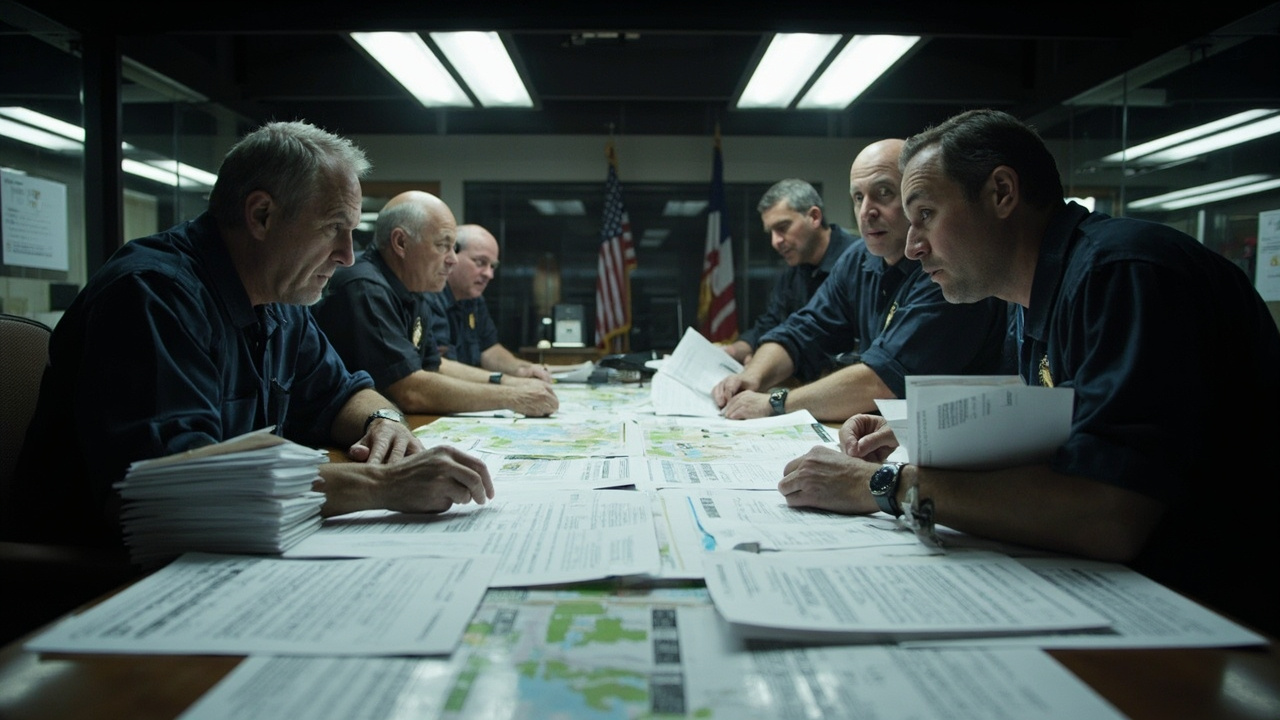
TL;DR: Only the President can issue an emergency or major disaster declaration under the Stafford Act, and a governor or tribal chief executive must ask first through FEMA.
A federal disaster declaration does not start with FEMA sending help on its own. It starts with a state or tribal finding that damage is too severe for state, local or tribal resources, documented through a joint damage assessment and sent to the President for a discretionary decision. That structure is described by FEMA's How a Disaster Gets Declared.
Only the President decides
All emergency and major disaster declarations are made solely at the discretion of the President of the United States, according to FEMA's How a Disaster Gets Declared.
That discretion is the answer to the most common household misunderstanding. A severe storm, flood, fire or other incident does not automatically create federal eligibility. FEMA evaluates and recommends, but the declaration itself is presidential.
The law behind that process is the Robert T. Stafford Disaster Relief and Emergency Assistance Act, 42 U.S.C. §§ 5121-5207. FEMA states that it has codified the declaration process at 44 C.F.R. Part 206, Subpart B.
Who is allowed to ask
For a major disaster, the Stafford Act §401 provides that all requests for a declaration by the President that a major disaster exists shall be made by the governor of the affected state, as summarized on FEMA's How a Disaster Gets Declared.
For declaration purposes, “state” covers more than the 50 states. FEMA lists the District of Columbia, Puerto Rico, the Virgin Islands, Guam, American Samoa and the Commonwealth of the Northern Mariana Islands. The Republic of the Marshall Islands and the Federated States of Micronesia are also eligible to request a declaration and receive assistance through the Compacts of Free Association.
Federally recognized tribal governments have the option to request a presidential disaster declaration independent of a state. That tribal option followed the Sandy Recovery Improvement Act, and FEMA developed Tribal Declarations Pilot Guidance with more detailed guidance for tribal requests.
The parallel tribal authority is also written into federal law. 42 USC 5170: Procedure for declaration provides that the chief executive of an affected Indian tribal government may submit a request for a declaration that a major disaster exists consistent with the requirements that apply to a governor’s request. The same section preserves the ability of a tribal government to receive assistance through a state-requested declaration for the same incident when the President does not issue a separate tribal declaration.
Step 1: Joint Preliminary Damage Assessment
When it appears that a presidential declaration may be needed to help an impacted area recover, the state or tribal government should contact its FEMA Regional Office and ask for a joint federal, state or tribal Preliminary Damage Assessment, referred to as a PDA.
Local government representatives should be included when possible. Federal regulation describes PDA teams as including at least one federal representative and one state representative, with a local representative familiar with the extent and location of damage also included when possible. Other agencies and voluntary relief organizations may take part as needed.
The joint team examines the impacted area to determine the extent of the disaster, its effect on individuals and public facilities, and the kinds of federal help that may be required. FEMA describes the PDA as a mechanism for measuring impact, magnitude and unmet needs across individuals, businesses, the public sector and the community as a whole.
The state uses the information as support for the governor’s request. FEMA uses it to document the recommendation sent to the President in response to that request. After field work, FEMA consults with state officials to discuss findings and reconcile differences.
FEMA is responsible for briefing team members on damage criteria, the information to be collected for the particular incident and reporting requirements. The state is responsible for coordinating state and local participation and ensuring timely notice of the schedule.
For households, the practical point is that early local damage reports matter. The PDA validation process begins with information gathered by state and local officials. Reporting damage to local emergency management, documenting losses and allowing inspectors access helps form the record that supports or limits a later request.
Step 2: Finding that local and state resources are overwhelmed
After the PDA is complete and the state or tribal government concludes that damage exceeds its resources, the governor or tribal chief executive may submit a declaration request to the President through the FEMA Regional Office.
The request must show that the disaster is of such severity and magnitude that effective response is beyond the capabilities of the state and affected local governments, or the tribal government, and that supplemental federal assistance is necessary. That finding is the legal core of the request.
As part of the request, the governor or tribal chief executive must take appropriate action under state or tribal law and direct execution of the state or tribal emergency plan. 42 USC 5170: Procedure for declaration describes this as taking appropriate response action under state law and directing execution of the state’s emergency plan as a prerequisite to major disaster assistance.
The request must also describe the resources committed. The governor or tribal chief executive furnishes information on the nature and amount of state and local, or tribal, resources already committed or to be committed to alleviating the results. Federal law adds that state commitments must be a significant proportion of the state and local obligations and expenditures.
The request must estimate damage and need. That includes an estimate of the amount and severity of damage, the impact on private and public sectors, and the type and amount of assistance needed under the Stafford Act.
Finally, the governor or tribal chief executive must certify that state and local or tribal obligations and expenditures for the current disaster will comply with applicable cost-sharing requirements. For tribal governments, the President may waive or adjust payment of a non-federal contribution where separate authority allows a waiver and the President determines the waiver or adjustment is necessary and appropriate.
Exception for obviously catastrophic events
Normally the PDA is completed before the governor or tribal chief executive submits the major disaster request. When an obviously severe or catastrophic event occurs, however, the request may be submitted before the PDA is complete.
In those early-request cases, the major disaster generally is limited to Public Assistance Categories A and/or B, which may be further limited to Direct Federal Assistance, plus Hazard Mitigation Assistance. For high-impact events where residential damage is empirically overwhelming, the declaration may also include Individual Assistance.
Additional forms of assistance may be added later after PDAs are completed. Federal regulation separately allows waiver of the joint PDA for incidents of unusual severity and magnitude that do not require field assessments to establish the need for supplemental federal help, or in other instances determined by the regional administrator in consultation with the state.
A related rapid tool involves Department of Defense resources. In the immediate aftermath of an incident that may ultimately qualify for a presidential declaration, when threats to life and property cannot be handled effectively by state or local governments, designated FEMA leadership may direct Defense Department personnel and equipment to be used for debris and wreckage removal and temporary restoration of essential public facilities and services.
The two declaration types are different
The Stafford Act provides for two types of declarations: emergency declarations and major disaster declarations. Both allow the President to provide supplemental federal disaster assistance, but the triggering events, scope and amount of assistance differ.
The President can declare an emergency for any occasion or instance when the President determines federal assistance is needed. Emergency declarations supplement state, local or tribal efforts to provide emergency services, such as protection of lives, property, public health and safety, or to lessen or avert the threat of a catastrophe in any part of the United States.
Major disaster declarations are generally issued after catastrophes occur and provide broader authority for federal agencies to supply supplemental help to state and local governments, families and individuals, and certain nonprofit organizations for recovery.
Emergency assistance has a funding control. The total amount of assistance provided in a single emergency may not exceed $5 million. The President reports to Congress if that amount is exceeded.
Deadlines and routing families should understand
Both emergency and major disaster requests go to the President through the FEMA Regional Administrator. The governor of the affected state or tribal chief executive of the affected tribe must submit an emergency request within 30 days after the incident occurred. Extensions are possible when requested in writing within that 30-day period.
Households should not wait for a declaration to act. Because the governor or tribal chief executive must document committed resources, activated emergency plans, damage severity, private- and public-sector effects and specific Stafford Act needs, the weeks before and after a request are when local documentation is most important. Keep a simple file with photos, receipts, insurance correspondence and repair estimates.
A declaration also defines time and place. Federal regulation uses the term incident period for the interval during which the disaster-causing incident occurs. Federal assistance generally is not approved unless the damage or hardship resulted from the incident that took place during the incident period or in anticipation of that incident. The incident period is established by FEMA in the FEMA-State Agreement and published in the Federal Register.
The FEMA-State Agreement is the formal legal document stating the understandings, commitments and binding conditions for assistance resulting from the presidential declaration. Its existence is another reason households should read the declaration notice carefully: covered counties, covered programs and covered dates can differ by event.
In short, the path is assessment, documented overwhelm, formal request through the region, and presidential decision — emergency or major disaster — with scope set by law and the facts found on the ground.