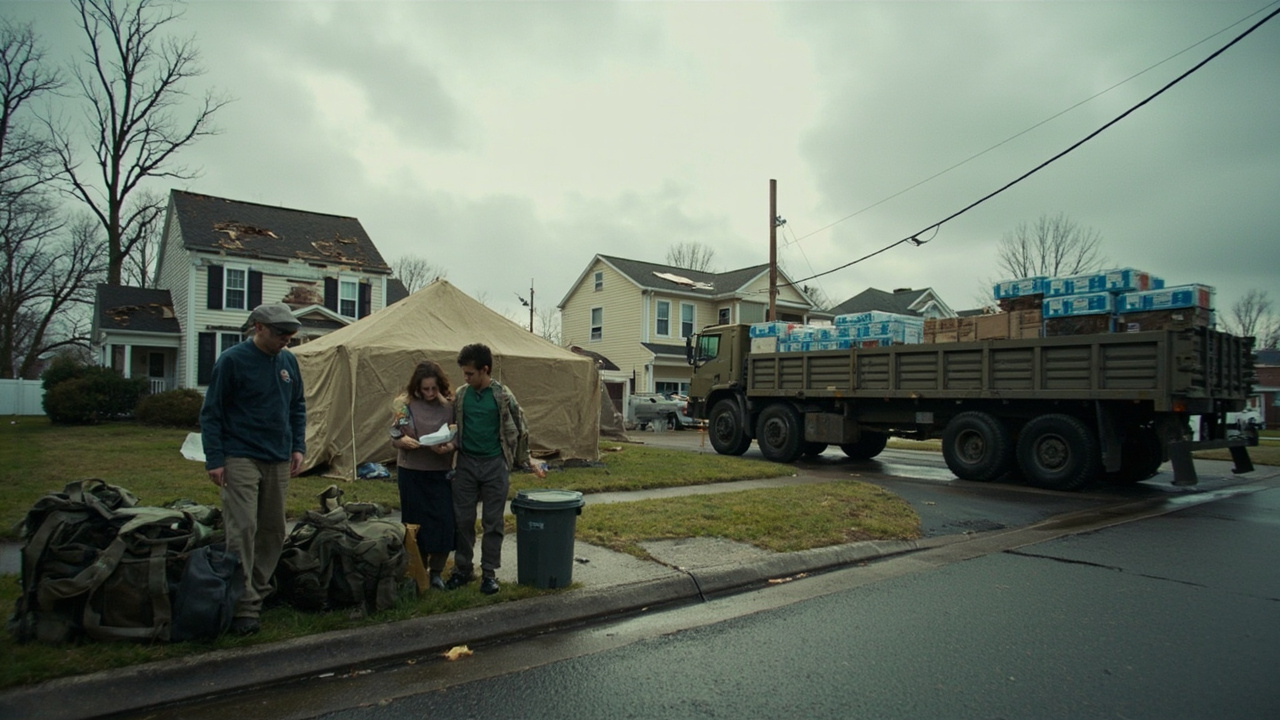
TL;DR: A federal disaster declaration is a presidential finding under the Stafford Act that local and state capacity is overwhelmed, and only a major disaster declaration unlocks full household grants, public rebuilding funds, and small-business loans.
For households mapping evacuation readiness and emergency food, water and power plans, the declaration system decides what outside help can arrive and when. According to LegalClarity's “Disaster Declaration: What It Is and How It Works”, published May 27, 2026, a declaration is a formal government determination that a catastrophe has overwhelmed a community's ability to respond on its own.
That finding does not happen on its own. It follows a defined request, assessment, and approval chain set out in federal law.
Why declarations control household recovery
At the federal level, the president issues declarations under the Robert T. Stafford Disaster Relief and Emergency Assistance Act, codified at 42 U.S.C. § 5121 and following sections. No federal disaster money moves until the president formally states that a disaster or emergency exists.
The practical reason is tiered responsibility. Local firefighters, police, and emergency medical teams respond first. When needs exceed local budgets, personnel, and equipment, the state adds resources through its emergency management agency. Federal programs enter only after the governor shows that combined state and local capability is insufficient.
For families, that structure explains why early self-reliance matters. Search and rescue, bottled water, ready-to-eat meals, generators, and emergency shelter come through different authorities than long-term repair grants. Knowing which declaration is in place tells a household whether to expect short-term protective measures or a longer registration-based aid process.
How a governor's request moves to the president
Federal disaster declarations do not start in Washington. The governor of the affected state must formally ask the president for help.
According to LegalClarity's “Disaster Declaration: What It Is and How It Works”, the governor must show that the event is severe enough that state and local governments cannot handle it alone. The governor must also certify that the state has already activated its own emergency plan and committed its own resources before seeking federal support.
The request travels through the FEMA Regional Administrator and must describe state and local resources already committed. The statute behind that step is 42 USC 5170 for major disasters and 42 USC 5191 for emergencies. Tribal chief executives follow a parallel direct path to the president and do not need to go through a governor.
Timing rules shape preparedness calendars. A governor or tribal chief executive must submit the request within 30 days of the incident, with guidance to file within five days after the need becomes apparent. Extensions must be requested in writing within that initial 30-day window, as described in LegalClarity's “What Is a Basic Premise of the National Response Framework?”, published May 26, 2026.
That clock is separate from the survivor registration clock that starts later.
How damage assessors measure overwhelm
Before the request, federal and state teams conduct a Preliminary Damage Assessment to quantify destruction.
Teams survey damaged homes, public buildings, roads, and utilities to estimate recovery costs. FEMA compares those estimates against per-capita indicators to judge whether local budgets can absorb the loss.
For fiscal year 2026, the statewide per-capita indicator is $1.94 and the countywide indicator is $4.86. Those figures appear in FEMA's Per Capita Impact Indicator and Project Thresholds material summarized in both LegalClarity explainers.
The indicators are not automatic pass-fail lines. FEMA also weighs concentration of damage, insurance coverage in the area, local fiscal capacity, and recent disaster history in the same area. The purpose is to document a gap between community need and ability to pay.
Household takeaway: photograph damage, keep addresses and insurance details together, and report damage to local officials promptly. Assessments rely on visible, countable loss across homes and public systems.
Emergency declaration versus major disaster declaration
Federal law creates two presidential declaration types with very different aid consequences.
An emergency declaration is narrower. It authorizes federal agencies to coordinate response and provide short-term protective measures focused on saving lives and protecting property. Total federal spending under a single emergency declaration is capped at $5 million unless the president finds a higher amount is immediately required and notifies Congress, under 42 USC 5193.
Emergency declarations fit fast-moving situations where federal coordination is needed but the full recovery portfolio may not be warranted.
A major disaster declaration is broader. The governor requests it by showing severity and magnitude beyond state and local capability under 42 USC 5170. The statute defines a major disaster to include natural catastrophes such as hurricanes, tornadoes, earthquakes, volcanic eruptions, floods, droughts, and wildfires that warrant supplemental federal aid, as defined in 42 USC 5122.
Only a major disaster declaration makes the complete range available: individual assistance for households, public assistance for infrastructure, hazard mitigation grants, SBA disaster loans, and related programs. Most programs people associate with FEMA help require this larger declaration type.
Tribal governments can request emergency declarations directly from the president, independent of the state process, under 42 USC 5191. Since the Sandy Recovery Improvement Act of 2013 amended the Stafford Act, federally recognized tribal governments may also seek major disaster declarations on their own. Tribes that prefer coverage under a state declaration may still do so, and the president may adjust cost shares for tribal governments when warranted.
What Individual Assistance can pay for
When a major disaster declaration includes Individual Assistance, FEMA can provide money and direct services through the Individuals and Households Program, known as IHP.
IHP grants do not need to be repaid. They cover necessary expenses and serious needs not covered by insurance or other sources.
Housing Assistance includes:
- Financial help to rent another place while a home is uninhabitable
- Reimbursement for hotel stays
- Funds to repair an owner-occupied primary residence to a safe and livable condition, including private utilities and access roads
- Financial assistance toward replacing a destroyed primary residence
- In some cases, a temporary housing unit provided directly when local rental stock is unavailable
Repair aid is intended to make a home habitable, not to restore pre-disaster condition. FEMA must verify that the applicant lived in the damaged home as a primary residence, and homeowners must show ownership before receiving repair or replacement funds.
Other Needs Assistance helps with disaster-caused costs beyond housing, including medical and dental expenses, funeral costs, damaged personal property such as furniture, appliances and computers, moving and storage, childcare, and other serious needs.
The maximum IHP grant is $43,600 for housing assistance and a separate $43,600 for other needs assistance per household per disaster, under the most recent published adjustment. Most awards fall below those caps.
A duplication-of-benefits rule applies. FEMA cannot duplicate payments from insurance, charitable organizations, or other federal programs. Survivors must file insurance claims first and report settlements. If insurance later pays for the same expense FEMA covered, the FEMA payment for that expense must be returned.
How to register within the 60-day window
After a presidential declaration that includes individual assistance, survivors typically have 60 days from the declaration date to register. That period starts on the declaration date, not when a family finishes assessing damage.
There are four ways to apply:
- Online through DisasterAssistance.gov
- Through the FEMA mobile app
- By phone to the FEMA Helpline at 800-621-3362, with multilingual support
- In person at a Disaster Recovery Center once centers open, or with Disaster Survivor Assistance teams going door to door
FEMA asks for Social Security number, address of the damaged property, current contact information, insurance details, and a description of damage. Survivors who lost documents can provide alternative proof of residence and ownership. A destroyed deed or lease does not block registration.
Households should register early even while damage assessment continues, keep the FEMA registration number, and update contact information if displaced. Missing the window can mean losing access to grants and related aid.
What Public Assistance and cost-sharing rebuild
The second large category is Public Assistance for governments and certain nonprofits, alongside hazard mitigation funding.
Public Assistance supports emergency work, debris removal, and repair of roads, bridges, public buildings, utilities, and other infrastructure. Federal involvement does not replace local leadership. Local officials retain authority even when federal teams arrive.
Assistance is shared, not fully federally funded. The Stafford Act provides that the federal government covers at least 75 percent of eligible costs for emergency work, infrastructure repair, and hazard mitigation, with state and local governments responsible for the remainder. In catastrophic events the president can increase the federal share. Small, impoverished communities may qualify for up to 90 percent federal cost sharing on certain mitigation activities.
For resilient homes and neighborhoods, mitigation matters most during rebuilding. Elevating structures in floodplains, enforcing building codes in earthquake-prone areas, and hardening utility infrastructure reduce future loss. Recovery linked to mitigation funding is the point where a community can rebuild stronger rather than restoring the same vulnerability.
Loans, tax relief, and other recovery programs
Grants are only part of the system. The U.S. Small Business Administration offers low-interest disaster loans for damaged homes, businesses, and nonprofits, which must be repaid. Internal Revenue Service provisions can provide tax relief, extended filing timelines, and casualty-loss treatment after designated disasters. Disaster unemployment assistance, crisis counseling, legal aid, and long-term community rebuilding funds may also activate depending on the declaration language.
Each program has its own eligibility rules and county designations. A statewide declaration does not automatically include every county for every program. Households should check the declaration notice for listed counties and included assistance types before assuming eligibility.
What to do before any declaration
Keep a go-bag, water, food, medications, power backups, and paper copies of identification, insurance policies, leases or deeds, and bank details where they can be grabbed during evacuation. Store photos of each room and utility connections. Know evacuation routes and a meeting point outside the immediate area. Track official county and state emergency management alerts alongside FEMA updates.
Understanding declarations will not prevent damage, but it shortens the path from impact to application when every day counts.
Sources referenced
- Disaster Declaration: What It Is and How It Works - LegalClarity (https://legalclarity.org/disaster-declaration-what-it-is-and-how-it-works/)
- What Is a Basic Premise of the National Response Framework? - LegalClarity (https://legalclarity.org/what-is-a-basic-premise-of-the-national-response-framework/)