TL;DR: Only the President can issue a federal emergency or major disaster declaration under the Stafford Act, after a Governor or Tribal Chief Executive shows state, local and tribal resources are overwhelmed — usually with a joint Preliminary Damage Assessment.
Presidential authority is the final step
All emergency and major disaster declarations are made solely at the discretion of the President of the United States, according to FEMA's How a Disaster Gets Declared.
That page states it provides procedural information regarding the Stafford Act declaration process and is intended for emergency managers, elected officials, media, and stakeholders interested in the formal declaration process.
Both declaration types authorize the President to provide supplemental federal disaster assistance. The events related to the two different types of declaration and the scope and amount of assistance differ.
For households, the practical meaning is direct: local response comes first, state or tribal resources come next, and federal help is supplemental. A declaration does not replace local action.
The law behind declarations
The authority is the Robert T. Stafford Disaster Relief and Emergency Assistance Act, 42 U.S.C. §§ 5121-5207, cited on FEMA's How a Disaster Gets Declared.
Section 401 of that Act states in part that all requests for a declaration by the President that a major disaster exists shall be made by the Governor of the affected State.
For declaration purposes, a State also includes the District of Columbia, Puerto Rico, the Virgin Islands, Guam, American Samoa, and the Commonwealth of the Northern Mariana Islands.
The Republic of Marshall Islands and the Federated States of Micronesia are also eligible to request a declaration and receive assistance through the Compacts of Free Association.
FEMA has codified the declaration process at 44 C.F.R. Part 206, Subpart B. That regulation organizes how requests are submitted, evaluated, and forwarded for presidential action.
Tribal nations can request directly
Federally recognized tribal governments have the option to request a presidential disaster declaration independent of a state, according to FEMA's How a Disaster Gets Declared.
That option was created as a result of the Sandy Recovery Improvement Act. Before that change, requests flowed through governors.
FEMA has developed Tribal Declarations Pilot Guidance, which provides more detailed and specific guidance for tribal requests. Federally recognized Indian tribal governments now have the option of pursuing a declaration directly from the President.
For family preparedness, the lesson is to know which government serves your address. Households on tribal land follow tribal emergency information, while other households follow city, county, and state direction.
What a Preliminary Damage Assessment does
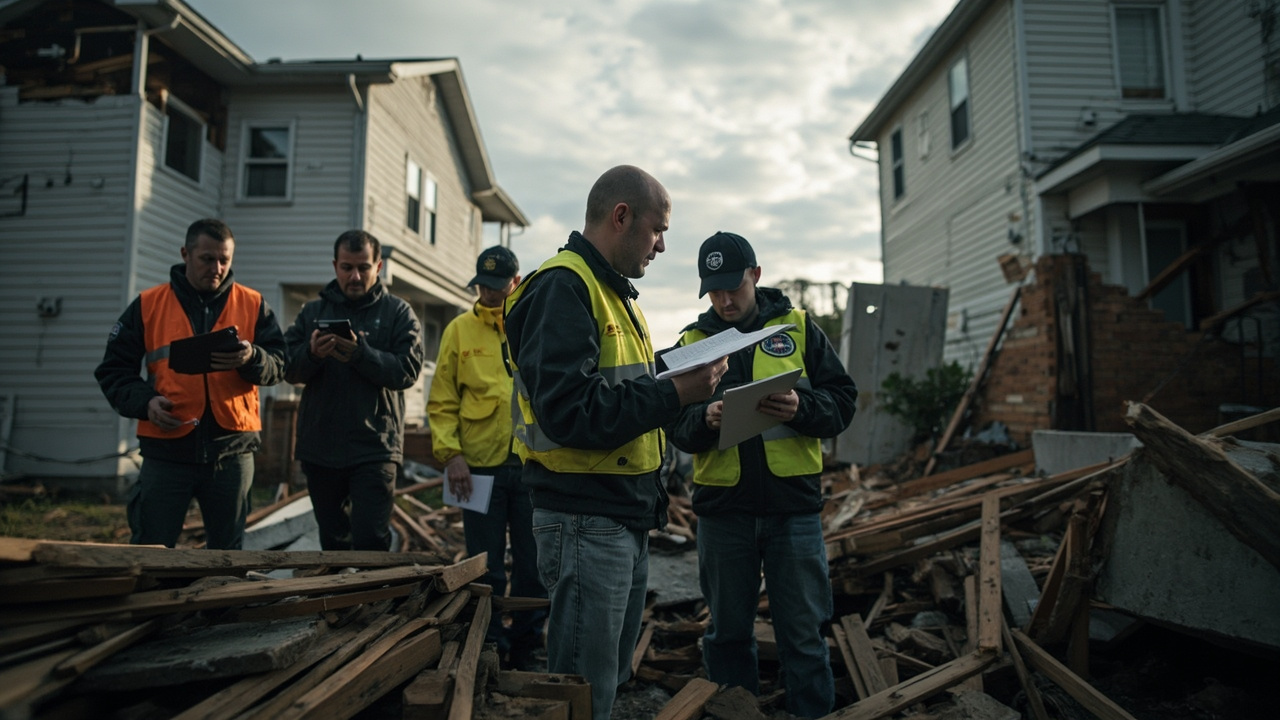
If it is apparent that a presidential disaster declaration may be necessary to assist in the recovery of the impacted area, the State or Indian tribal government should contact their FEMA Regional Office and request a joint Federal, State/Tribal Preliminary Damage Assessment, according to FEMA's Preliminary Damage Assessments page.
Local government representatives should be included, if possible. Together, the team conducts a thorough assessment of the impacted area.
The assessment determines the extent of the disaster, its impact on individuals and public facilities, and the types of federal assistance that may be needed.
This information is included in the Governor or Tribal Chief Executive's request to show that the disaster is of such severity and magnitude that effective response is beyond the capabilities of the State and the affected local governments or Indian tribal government and that supplemental federal assistance is necessary.
Step 1: Local damage assessment comes first
The process starts at the local level where damage details are initially collected, with state, tribal and territorial authorities, according to FEMA's Preliminary Damage Assessments page.
FEMA provides Digital Damage Survey templates or Street Sheets to help with collection of damage information during this local phase.
The standardized approach matters because early reports shape later decisions about state verification and a possible joint assessment.
Households can support accuracy by documenting damage clearly and reporting through the local channels identified by local officials.
Step 2: State or tribal verification and the 30-day window
The state, tribe or territory will collect Initial Damage Assessment information and generally has 30 days from the start of the incident to determine whether federal assistance may be necessary, according to FEMA's Preliminary Damage Assessments page.
The programs considered at that point include FEMA Individual Assistance, Public Assistance, or other federal programs.
FEMA provides Initial Damage Assessment Checklists to guide emergency management officials through collection of essential information.
If the damage is extensive enough that it exceeds the recovery capacity of a state, tribe, or territory, a formal Joint PDA may be requested through the example PDA Request Letter Template provided. An overall Narrative Summary of Impacts can give the FEMA Joint PDA Team valuable, big picture context about the disaster's impact beyond just the data.
Not every incident will result in the need for a PDA or federal assistance.
Step 3: Joint PDA planning with the Regional Office
Once a request for a Joint PDA is made, the information verified by the requesting organization should be provided to the FEMA Regional Recovery Division, according to FEMA's Preliminary Damage Assessments page.
FEMA programmatic representatives will coordinate with the requesting organization to discuss the information submitted, determine team requirements, establish a PDA briefing time and location, and develop an overall PDA coordination plan.
PDAs can be in-person or virtual depending on the level of information available in the Initial Damage Assessment.
The July 2025 FEMA Preliminary Damage Assessment Guide frames this as a coordinated operation, not a single-agency visit. Team composition, briefing, and coordination planning are set before field or virtual work begins.
Step 4: Conducting the Joint PDA
FEMA, and potentially other federal agencies, will conduct the joint PDA in accordance with the agreed upon PDA coordination plan, according to FEMA's Preliminary Damage Assessments page.
At the conclusion of the PDA the validated and agreed upon information will be returned to the requesting organization to decide if a request for a Disaster Declaration is warranted.
The July 2025 FEMA Preliminary Damage Assessment Guide describes methodologies that teams may use, including self-reporting, door-to-door assessments, digital surveys, validation tools, site assessments, windshield surveys, virtual sensing, geographic information systems, modeling, and desktop assessments.
The guide also separates Individual Assistance and Public Assistance assessments. Individual Assistance work examines homes and personal impacts, including damage levels for manufactured homes and for conventionally built homes and multi-family homes. Public Assistance work inventories damage to public facilities and documents categories of work, insurance coverage, hazard mitigation projects, localized impacts, recent multiple disasters, and other federal agency programs.
Digital surveys and shared data
FEMA's damage assessment survey templates for both Individual and Public Assistance are available for state, local, tribal and territorial partners to use during the Initial Damage Assessment process, according to FEMA's Preliminary Damage Assessments page.
The standardized input fields allow jurisdictions to collect the same information that FEMA gathers during the Joint PDA operation. This information is used to determine whether the jurisdiction is eligible for a disaster declaration.
The data captured using these templates is immediately available in the jurisdiction's ArcGIS Platform and can assist in FEMA's review of the damages in the event a Joint PDA is requested.
Listed templates include the PDA Individual Assistance Damage Assessment Survey Template v4.1.0, the PDA Public Assistance Damage Inventory Survey Template v4.1.0, the PDA Public Assistance Damage Assessment Survey Template v4.1.0, and the PDA Narrative Report Survey Template v1.0.0.
FEMA can accept initial damage assessment geospatial datasets from state, tribal, and territorial governments for upload into FEMA's PDA Operations Hub System. The FEMA Regional Office can review this data for situational awareness when coordinating logistics for a Joint PDA field operation or for remote validation during a virtual Joint PDA operation.
Survey123 for PDAs enables FEMA and state, local, tribal, and territorial partners to electronically collect, submit and validate damage assessment information immediately following a disaster. The survey utilizes GIS technology and allows users to collect detailed damage information including location, category of damage, ownership and insurance information, cost estimates, and other local community impact information.
Step 5: The Governor or Tribal Chief Executive requests a declaration
Once the PDA is complete and the State or Indian tribal government determines that the damage exceeds their resources, the Governor or Tribal Chief Executive may submit a declaration request to the President through their FEMA Regional Office, according to FEMA's How a Disaster Gets Declared.
As part of the request, the Governor or Tribal Chief Executive must take appropriate action under State or Tribal law and direct the execution of the State or Tribal emergency plan.
The Governor or Tribal Chief Executive shall furnish information on the nature and amount of State and local or Indian tribal government resources that have been or will be committed to alleviating the results of the disaster, provide an estimate of the amount and severity of damage and the impact on the private and public sectors, and provide an estimate of the type and amount of assistance needed under the Stafford Act.
In addition, the Governor or Tribal Chief Executive must certify that, for the current disaster, State and local governments or Indian tribal government obligations and expenditures will comply with all applicable cost-sharing requirements.
When a request can move before the PDA is finished
Generally, the PDA is completed prior to submission of the Governor or Tribal Chief Executive's request for a major disaster declaration, according to FEMA's How a Disaster Gets Declared.
However, when an obviously severe or catastrophic event occurs, the request may be submitted prior to completion of the PDA, as provided in 44 C.F.R. §206.36.
In such circumstances the major disaster will generally be limited to Public Assistance Categories A and/or B, which may be further limited to Direct Federal Assistance, and Hazard Mitigation Assistance.
For high-impact events where the level of damage to residences is empirically overwhelming, the declaration may also include Individual Assistance. Additional forms of assistance may be added at a later date, pending completion of PDAs.
That expedited path explains why early federal announcements sometimes list only emergency work and mitigation at first, with more programs added after assessments are complete.
Emergency declarations have a dollar limit and 30-day request rule
The President can declare an emergency for any occasion or instance when the President determines federal assistance is needed, according to FEMA's How a Disaster Gets Declared.
Emergency declarations supplement State and local or Indian tribal government efforts in providing emergency services, such as protection of lives, property, public health, and safety, or to lessen or avert the threat of a catastrophe in any part of the United States.
The total amount of assistance provided for in a single emergency may not exceed $5 million. The President shall report to Congress if this amount is exceeded.
The Governor of the affected State or Tribal Chief Executive of the affected Tribe must submit a request to the President, through the appropriate Regional Administrator, within 30 days of the occurrence of the incident.