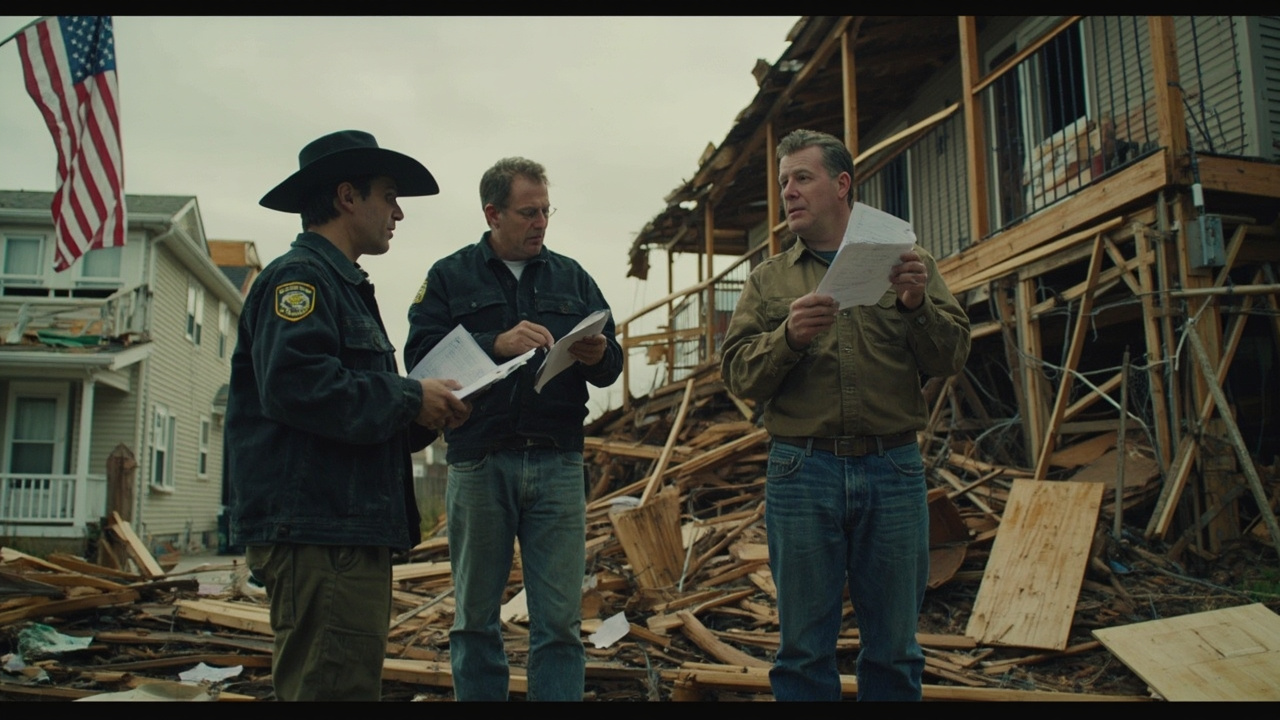
TL;DR: FEMA recommends Individual Assistance for a major disaster only after weighing six factors in 44 C.F.R. 206.48(b), and the President makes the final decision.
Federal help for households after a disaster does not turn on one damage count. According to Individual Assistance Declaration Factors | FEMA.gov, FEMA published a final rule on March 21, 2019, amending 44 C.F.R. 206.48(b), titled Factors considered when evaluating a Governor's request for a major disaster declaration, which revised the factors FEMA considers when evaluating a Governor's request for a major disaster declaration authorizing Individual Assistance.
That page states FEMA published the final rule as part of an effort to meet requirements in section 1109 of the Sandy Recovery Improvement Act (P.L. 113-2). The stated intent of the final rule is to provide more objective criteria, clarify the threshold for eligibility and speed the declaration process. The final rule and guidance became effective on June 1, 2019.
For households, the practical meaning is straightforward. A Governor must show that the disaster is of such severity and magnitude that effective response is beyond state and local capabilities and that supplemental federal assistance is necessary. FEMA evaluates the request, makes a recommendation, and all emergency and major disaster declarations are made solely at the discretion of the President of the United States, according to How a Disaster Gets Declared | FEMA.gov.
Who can request help and under what authority
The declaration process is set by the Robert T. Stafford Disaster Relief and Emergency Assistance Act, 42 U.S.C. §§ 5121-5207, according to How a Disaster Gets Declared | FEMA.gov. That page quotes Stafford Act §401 in part: "All requests for a declaration by the President that a major disaster exists shall be made by the Governor of the affected State."
On that same page, FEMA explains that a State also includes the District of Columbia, Puerto Rico, the Virgin Islands, Guam, American Samoa, and the Commonwealth of the Northern Mariana Islands. The Republic of Marshall Islands and the Federated States of Micronesia are also eligible to request a declaration and receive assistance through the Compacts of Free Association.
As a result of the Sandy Recovery Improvement Act, federally recognized Indian tribal governments now have the option of pursuing a declaration directly from the President. FEMA has developed Tribal Declarations Pilot Guidance, which provides more detailed and specific guidance for Tribal requests.
The IA factors described here have a defined scope. According to Individual Assistance Declaration Factors | FEMA.gov, the IA Declaration Factors apply only to state and territory major disaster declaration requests that include IA. FEMA is implementing guidance for tribal declarations on a separate, distinct track. The IA criteria for tribal declarations may be found in the Tribal Declaration Pilot Guidance. More information regarding the declaration process can be found at 44 C.F.R. Part 206, Subpart B.
FEMA has codified the declaration process at 44 C.F.R. Part 206, Subpart B, according to How a Disaster Gets Declared | FEMA.gov.
How a request reaches the President
When it appears a Presidential disaster declaration may be necessary, the State or tribal government should contact its FEMA Regional Office and request a joint Federal, State/Tribal Preliminary Damage Assessment, with local government representatives included if possible, according to How a Disaster Gets Declared | FEMA.gov.
Together, the team conducts an assessment of the impacted area to determine the extent of the disaster, its impact on individuals and public facilities, and the types of federal assistance that may be needed. That information is included in the Governor or Tribal Chief Executive's request to show that the disaster is of such severity and magnitude that effective response is beyond the capabilities of the State and affected local governments or tribal government and that supplemental federal assistance is necessary.
Once the assessment is complete and the State or tribal government determines damage exceeds its resources, the Governor or Tribal Chief Executive may submit a declaration request to the President through the FEMA Regional Office. As part of the request, the Governor or Tribal Chief Executive must take appropriate action under State or Tribal law and direct execution of the State or Tribal emergency plan.
The request must also furnish information on the nature and amount of State and local or tribal government resources committed to alleviating the results of the disaster, provide an estimate of the amount and severity of damage and the impact on the private and public sectors, and provide an estimate of the type and amount of assistance needed under the Stafford Act. The Governor or Tribal Chief Executive must certify that, for the current disaster, State and local or tribal government obligations and expenditures will comply with all applicable cost-sharing requirements.
This page was last updated August 12, 2026, according to Individual Assistance Declaration Factors | FEMA.gov.
The six Individual Assistance declaration factors
44 C.F.R. 206.48(b) establishes six Individual Assistance Declaration Factors, according to Individual Assistance Declaration Factors | FEMA.gov:
- State Fiscal Capacity and Resource Availability
- Uninsured Home and Personal Property Losses
- Disaster Impacted Population Profile
- Impact to Community Infrastructure
- Casualties
- Disaster Related Unemployment
FEMA directs readers to review the final rule and guidance. The linked guidance is titled Individual Assistance Declarations Factors Guidance, dated June 2019. That guidance states its purpose is to provide additional information regarding the manner in which FEMA will evaluate a request for Individual Assistance using the factors at 44 C.F.R. 206.48(b).
The guidance says it is intended to aid States and Territories in drafting requests for major disaster declarations authorizing Individual Assistance. It is also intended to provide additional clarity regarding the circumstances, in particular the severity and magnitude relative to State capacity, under which FEMA is likely to recommend or not recommend a declaration authorizing IA. The guidance states this additional clarity should allow for improved planning by the States and help States better understand how FEMA assesses whether an event exceeds a State's capacity to support residents without Stafford Act assistance. It also states that ultimately all major disaster declarations are made at the discretion of the President and the guidance in no way limits that discretion.
Factor 1: State Fiscal Capacity and Resource Availability
This factor looks at whether the state can handle resident needs without Stafford Act help. According to Individual Assistance Declaration Factors | FEMA.gov, useful references during the declarations process include Total Taxable Resources for States from the Treasury and Gross Domestic Product data from the Bureau of Economic Analysis, with GDP by State used for territories, metro areas, counties, and other areas.
In practice, a household should understand that this is a state-level comparison, not a judgment about one family. The request describes state and local resources already committed or to be committed, alongside damage estimates for private and public sectors. That resource picture frames the other five factors.
Factor 2: Uninsured Home and Personal Property Losses
This factor focuses on homes and belongings without another way to pay for repair or replacement. The June 2019 guidance describes the Individuals and Households Program as providing grants, direct assistance, or both, to eligible survivors with necessary expenses and serious needs they are unable to meet through other means, such as insurance, under 44 C.F.R. 206.110-120.
FEMA's IA page points requesters to homeownership rates from the Census Housing Vacancies and Homeownership survey, available for the United States, regions, states, and for the 75 largest Metropolitan Statistical Areas. It also points to an updated IHP Cost Projection Calculator, available through the Preliminary Damage Assessments resources page. Households can take a general step before any storm: keep insurance information where it can be found after an evacuation.
Factor 3: Disaster Impacted Population Profile
This factor asks who was hit and whether those residents face added barriers to recovery. FEMA's IA page lists the Census datasets it points to for this part of the review: poverty rates through the Small Area Income and Poverty Estimates program, Supplemental Security Income data, population demographics by age and background through table DP05 5-Year Estimates for county-level review including under 18 years, 65 years and over, and American Indian and Alaska Native populations, disability-related population data through table S1810 5-Year Estimates for total civilian noninstitutionalized population, and language data through table B06007 5-Year Estimates for percent of population who speaks English less than very well.
The same page also points to unemployment data for states and for counties and the 50 largest cities from the Bureau of Labor Statistics. For families, the general lesson is to plan for members who may need extra help moving, communicating, or accessing services.
Factor 4: Impact to Community Infrastructure
This factor considers damage to the shared systems a neighborhood needs to function. The joint Preliminary Damage Assessment described in How a Disaster Gets Declared | FEMA.gov covers impact on individuals and public facilities and the types of federal assistance that may be needed.
When roads, utilities, schools, clinics, or other local facilities are damaged, households feel it as lost access to work, care, and supplies. That community effect is part of why a Governor's request must estimate impact on both private and public sectors.
Factor 5: Casualties
This factor accounts for people killed or injured. The June 2019 guidance describes the Crisis Counseling Program as assisting individuals and communities recovering from the effects of a natural or man-made disaster through community-based outreach and psycho-educational services under 44 C.F.R. 206.171.
That guidance notes supplemental federal funding for crisis counseling is available to the State through two grant mechanisms: the Immediate Services Program, which provides funds for up to 60 days of services immediately following a disaster declaration, and the Regular Services Program, which provides funds for up to nine months following a disaster declaration. It also describes Disaster Legal Services as providing legal assistance to low-income individuals who, prior to or as a result of the disaster, are unable to secure legal services adequate to meet disaster-related needs under 44 C.F.R. 206.164, with FEMA providing free legal help through an agreement with the Young Lawyers Division of the American Bar Association.
Factor 6: Disaster Related Unemployment
This factor looks at job loss tied to the event. FEMA's IA page points to Bureau of Labor Statistics unemployment data for states and for counties and the 50 largest cities as references during the declarations process.
The June 2019 guidance also describes the Disaster Case Management Program as a partnership between a disaster case manager and a survivor to develop and carry out a Disaster Recovery Plan, under 42 U.S.C. 5189d, involving assessment of verified disaster-caused unmet needs and development of a goal-oriented plan. For workers, a general preparedness step is to keep proof of employment and housing costs where they can be retrieved if a home is damaged.
What Individual Assistance can include
The June 2019 guidance states Individual Assistance consists of the Individuals and Households Program, the Crisis Counseling Program, Disaster Legal Services, and the Disaster Case Management Program, among the programs grouped as Individual Assistance.
For the Individuals and Households Program, the guidance says assistance may be housing assistance, including Temporary Housing, Repair, Replacement, and Semi-Permanent or Permanent Housing Construction, as well as Other Needs Assistance to meet medical, dental, child care, funeral, personal property, transportation, moving and storage, and other miscellaneous costs. A household does not need to decide program names in advance. The declaration request estimates the type and amount of assistance needed under the Stafford Act, and FEMA evaluates which help fits the documented losses.