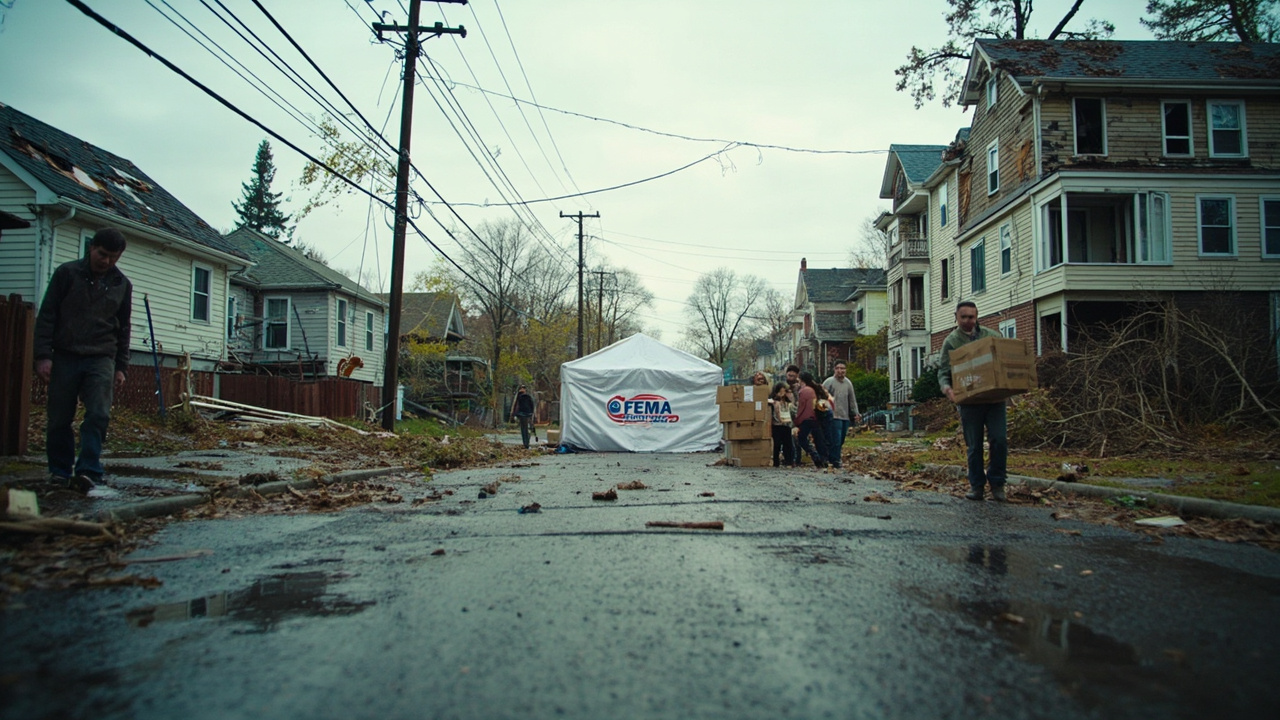
TL;DR: Federal disaster housing help reaches homeowners with far larger sums than renters, while regular rental programs help fill the gap after floods, storms and hurricanes.
What new research found on June 12
A study published June 12, 2026 in the International Journal of Disaster Risk Reduction examined how U.S. federal disaster aid is divided between homeowners and renters, and how non-disaster rental assistance responds after disasters, according to the study abstract indexed by Disaster aid and rental assistance: Examining federal housing support for homeowners and renters after disasters.
The authors are Qing Miao of Rochester Institute of Technology, Kelsea Best of The Ohio State University, Allison Reilly of University of Maryland, College Park, and Meri Davlasheridze of Texas A&M University at Galveston, according to the same abstract listing.
The work was supported by the National Science Foundation through a CAREER award titled Strengthening US Infrastructure and Communities through Science-Informed Disaster Policy and Engineering Civic Engagement, according to the funding note attached to the abstract.
The analysis used ZIP code-level longitudinal data to track allocations across programs, according to the abstract.
The central result is that the Individual and Households Program, known as IHP, and Small Business Administration disaster loans are open to both tenure groups yet deliver substantially more assistance to homeowners than to renters, according to the abstract.
How IHP and SBA dollars divide by tenure
The study reports that homeowner allocations of IHP aid and SBA loans are negatively associated with per capita income and housing values, according to the Disaster aid and rental assistance: Examining federal housing support for homeowners and renters after disasters abstract.
In other words, ZIP codes with lower income per person and lower home values received more of that homeowner aid in the data set examined, according to the abstract.
Those homeowner allocations were positively correlated with Black population share, suggesting that more homeowner aid reached economically vulnerable and racially diverse communities, according to the abstract.
The distribution of IHP aid and SBA loans for renters largely mirrored the homeowner pattern in the data, according to the abstract.
That mirroring means renter aid under those two programs also tilted toward lower-income, lower-value and higher-Black-share ZIP codes, according to the abstract description.
For households, the practical distinction remains scale: availability to both groups did not produce parity, because homeowners obtained substantially more help than renters, according to the abstract.
A separate June 11, 2026 analysis from Sabotaging Our Safety reported that homeowners received 2.5 times more Individual Assistance than renters between 2006 and 2018, according to that organization's summary of FEMA Review Council recommendations carried by Analysis Warns FEMA Changes Could Limit Aid - Biz New Orleans.
Why flood insurance and mitigation skew differently
By contrast, National Flood Insurance Program payouts and Hazard Mitigation Grant Program funds disproportionately favored wealthier localities in the study data, according to the International Journal of Disaster Risk Reduction abstract.
Those two programs also supplied significantly less support to ZIP codes with higher Black and Hispanic populations, according to the same abstract.
The contrast matters for preparedness planning because NFIP and HMGP operate under different eligibility and property-value mechanics than need-based IHP help, and the study found their geographic footprint favored higher-value areas, according to the abstract.
A June 11, 2026 policy analysis warned that a shift to expanded risk-based flood insurance pricing could reduce new NFIP policy uptake by 11% to 39%, with larger drops where premium increases are steepest, according to Analysis Warns FEMA Changes Could Limit Aid - Biz New Orleans.
That analysis also cited projected annual premium increases exceeding $2,000 in some high-risk areas and noted that the NFIP carried about $20 billion in debt, according to the Biz New Orleans account of the Sabotaging Our Safety report.
The analysis further estimated that the lowest-income ZIP codes could face a 25% to 60% decline in new flood insurance policies under full risk-based pricing, compared with 7% to 32% in the highest-income quartile, according to the Sabotaging Our Safety summary republished in that Biz New Orleans report.
How regular rental programs respond after disasters
The June 12 study also tracked non-disaster federal rental programs after flood and storm events, finding increased allocation of rental units to affected localities, according to the study abstract.
The Low-Income Housing Tax Credit program showed short-term growth in new unit development after events, according to the abstract.
Rental subsidies administered by the U.S. Department of Housing and Urban Development expanded more gradually but persistently, particularly after hurricanes, according to the abstract.
Both LIHTC and HUD programs were concentrated in low-income, renter-heavy and minority communities, reflecting effective targeting of socially vulnerable populations, according to the abstract.
The authors concluded that existing rental assistance programs can play a buffering role in disaster recovery, especially when disaster aid tends to underserve renters, according to the abstract.
For renters, that buffering function is relevant because direct disaster aid alone has provided less support than homeowner channels, according to the abstract finding on tenure disparity.
How to apply for FEMA Individual Assistance
Once the President issues a major disaster declaration, individual assistance programs open for residents in designated areas, according to How to Fill Out a FEMA Damage Assessment Form for Disaster Assistance - LegalClarity.
Residents can apply through four channels, with the online portal at DisasterAssistance.gov described as fastest, according to the LegalClarity guide summarizing FEMA procedures.
Other channels are the FEMA App available through the Apple App Store or Google Play, phone at 800-621-3362 with prompts for English, Spanish or other languages, and in-person visits to a Disaster Recovery Center, according to the same guide.
The online application asks users to create a Login.gov account and enter address, Social Security number, banking details for direct deposit, and insurance information, according to the guide.
Applicants can save a partial application and return later, and receive an application ID number at submission to use in future contacts with FEMA, according to the guide.
FEMA provides free interpretation and document translation for applicants with limited English proficiency, requestable through the FEMA Helpline at 800-621-3362, according to the guide.
Disaster Recovery Center staff can explain eligibility, answer questions and connect applicants with other programs including SBA disaster loans, according to the guide.
What documents prove occupancy and ownership
FEMA usually verifies occupancy through public records, according to the LegalClarity guide.
If that search does not confirm occupancy, applicants may be asked for a lease, rent receipt, utility bill, bank statement or motor vehicle registration showing the address, according to the guide.
Ownership, when not confirmed through public records, can be shown with a deed, mortgage paperwork, homeowners insurance documentation, property tax receipt, manufactured home title, purchase contract, will naming the applicant as heir with death certificate, receipts for major repairs within the five years before the disaster, or a court document, according to the guide.
Applicants are also asked for insurance details, including any settlement letter received, and for noting when a policy excludes the specific peril, such as a standard homeowner policy that excludes flood, according to the guide.
Bank account and routing numbers are requested when applicants prefer direct deposit rather than a mailed check, according to the guide.
Dated photographs from multiple angles showing waterlines, cracked foundations or collapsed roof sections, plus a written repair estimate from a licensed contractor listing materials, labor and costs, can support the file for the inspector, according to the guide.
Government teams use a separate Preliminary Damage Assessment to document structural losses and estimate overall economic impact before a governor or tribal executive requests a major disaster declaration, according to the guide.
Individual applicants do not assign FEMA damage categories themselves; joint assessment teams and FEMA inspectors determine whether a home is classified as affected, minor or higher levels of damage, according to the guide.
What recent disaster files show about timing and sums
For Arkansas Severe Storms and Tornadoes designated DR-4865-AR, the incident period was March 14, 2025 to March 15, 2025 and the declaration date was May 8, 2025, according to FEMA.gov Arkansas Severe Storms and Tornadoes page.
The application period for that disaster was closed by the time of the page update, and applicants were directed to check status at DisasterAssistance.gov, according to the same FEMA page.
Approved assistance in that file totaled $2,556,861.58 in Housing Assistance, $989,310.25 in Other Needs Assistance, and $3,546,171.83 in total Individuals and Households Program dollars, with 281 applications approved, according to the funding table last updated April 16, 2026 on that FEMA page.
After applying, FEMA reviews whether an inspection is needed to verify disaster-related damage to the home and personal property, and staff and inspectors may contact the applicant, according to the same FEMA page.
FEMA may request additional information to support eligibility or address specific disaster-related needs identified in the application, described in a letter to the applicant, according to the same FEMA page.
Applicants then receive a letter by email or mail explaining approval, amount, permitted use and appeal rights, according to the same FEMA page.
Separately, applications remained open through Saturday, June 13 for FEMA help to homeowners or renters with uninsured losses from March Kona-low storms in Honolulu, Hawaii or Maui counties, according to Off the news: Saturday deadline for Kona-low aid | Hawaii News Network posted June 11, 2026.
That aid covered damage to residences, vehicles or personal property, or emergency medical or childcare expenses not covered by insurance, according to the same Hawaii News Network item.
What proposed changes would mean for renters
A FEMA Review Council final report released May 7 proposed replacing 15 categories of Individual Assistance with a single capped payment available only when a home is rendered uninhabitable, according to the Biz New Orleans account published June 11, 2026.
Under that proposal, homeowner payments would be capped at $150,000, while renters would receive at most six months at Fair Market Rate, according to the same report.
Supporters said the approach could simplify programs and speed distribution, while critics said Fair Market Rate often falls below actual post-disaster rents and property-level determinations would disadvantage renters, according to the same Biz New Orleans account.
The same Council proposal would raise the per-capita indicator for a federal declaration by 54%, which the Sabotaging Our Safety analysis estimated would have excluded 29% of declarations from 2012 to 2025 and reduced declarations by about 16 per year, according to the Biz New Orleans account.
The Council also proposed replacing Public Assistance reimbursement, which had delivered about $180 billion in recovery grants, with a formula-based block grant called RAPID tied to metrics such as wind speed and flood depth, with an eight-year spend-or-return rule and a federal cost share of 50% to 75% tied to preparedness benchmarks, according to the same account.