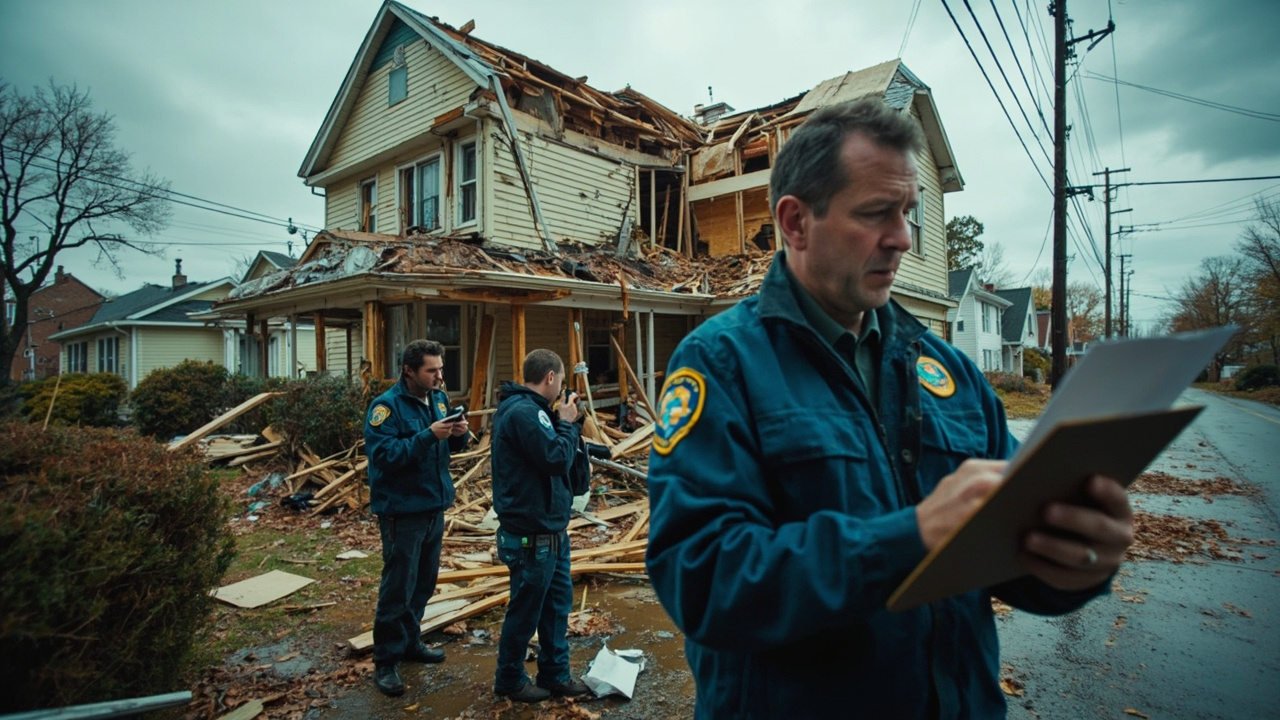
TL;DR: A Preliminary Damage Assessment proves a disaster exceeded state and local recovery capacity through a local Initial Damage Assessment followed by a Joint PDA with FEMA that supports the Governor's request for a presidential major disaster declaration.
Why the PDA controls federal aid
A Preliminary Damage Assessment is the formal review used to decide whether a disaster has overwhelmed the ability of state or local government to recover without federal help, according to LegalClarity's Preliminary Damage Assessment guide.
The review happens in two stages. Local officials survey destruction and compile cost estimates first. Federal teams then verify those figures on the ground.
The verified figures feed directly into the Governor's request for a presidential major disaster declaration. That declaration unlocks federal funding for public infrastructure repair and for individual household assistance.
Errors in the numbers or missed steps in the sequence can delay or prevent federal aid for an entire community.
Households should understand this link because Individual Assistance is not automatic after a storm, flood, wildfire or tornado. As explained in LegalClarity's Federal Disaster Assistance guide, the governor must request a presidential declaration through the appropriate FEMA Regional Administrator, generally within 30 days of the event, with evidence that damage exceeds state capacity, an estimate of losses, and certification that the state will meet cost-sharing obligations.
An approved declaration specifies which counties are covered and which programs are authorized. Some declarations authorize only Public Assistance for government infrastructure, while others authorize Individual Assistance for households, and many authorize both.
Local assessment comes first
The damage assessment process starts at the local level, not with FEMA, according to LegalClarity's Preliminary Damage Assessment guide.
After immediate life-safety threats have passed, local emergency managers collect damage information and report it upward to state or tribal authorities. This first phase is called an Initial Damage Assessment, or IDA.
The state, tribe or territory generally has 30 days from the start of the incident to gather IDA data and decide whether federal assistance may be necessary, citing FEMA's Preliminary Damage Assessments guidance.
For catastrophes of unusual severity, a governor can submit an abbreviated written request to move faster, according to LegalClarity's Federal Disaster Assistance guide.
If IDA data indicates damage exceeds state recovery capacity, state officials request a Joint Preliminary Damage Assessment from the appropriate FEMA regional office. That request brings the federal government into field verification.
FEMA programmatic staff then coordinate with the requesting organization to discuss data already collected, determine how many assessment teams are needed, and develop an overall plan for verifying damage in the field.
The joint PDA is the assessment FEMA relies on when recommending for or against a presidential declaration. A thorough IDA makes the joint PDA faster and stronger in supporting the state's case.
How homes are classified in the field
Assessment teams classify every inspected home into one of four categories, and those classifications drive the eligibility calculation for Individual Assistance, according to LegalClarity's Preliminary Damage Assessment guide.
The four categories, from least to most severe, are Affected, Minor, Major and Destroyed.
Affected means non-structural damage that does not make the home unsafe to enter or occupy.
Minor means repairable, non-structural damage or minimal flood-related damage.
Major means structural damage or significant flood damage requiring extensive repairs.
Destroyed means damage severe enough that the home is a total loss.
These definitions come from FEMA's PDA Pocket Guide carried by field teams during inspections.
The number of homes rated Major and Destroyed carries the most weight in the declaration decision. A county with 500 homes showing minor water marks presents a different case from a county with 500 homes that lost roofs, even when raw counts match.
For households, the Individuals and Households Program under Section 408 of the Stafford Act is the main vehicle for direct federal grants, split into Housing Assistance and Other Needs Assistance, according to LegalClarity's Federal Disaster Assistance guide.
Each category has its own maximum award of $43,600 for disasters declared on or after October 1, 2024, as published in the Federal Register notice on maximum assistance. Those figures are caps, not guaranteed payments, and FEMA determines actual awards from verified losses.
Housing Assistance can include rental assistance for displaced occupants of a damaged primary residence, lodging expense reimbursement for hotel or motel costs during initial displacement, and grants to repair or replace an owner-occupied primary residence so it is safe to occupy again.
Other Needs Assistance can include funds for appliances, furnishings, computers and work or school items, help for disaster-caused medical and dental costs including prescription replacement and medical equipment, reimbursement for disaster-caused funeral and burial costs, money to repair or replace a vehicle needed for daily use, and assistance for increased child care costs resulting from the disaster.
What local officials must have ready
Before federal teams arrive, local emergency managers need site-specific data ready, according to LegalClarity's Preliminary Damage Assessment guide.
That means exact street addresses and GPS coordinates for damaged structures, plus photographs and initial repair cost estimates. FEMA provides standardized survey templates for Individual Assistance and for Public Assistance that states and localities can use during the IDA phase.
For public infrastructure, local officials sort damage into the work types FEMA uses to process Public Assistance grants. The main groups are debris removal as Category A, emergency protective measures as Category B, roads and bridges as Category C, water control facilities as Category D, public buildings as Category E, public utilities as Category F, and parks and recreational facilities as Category G, citing FEMA's Public Assistance Fact Sheet.
Each damaged facility needs a documented insurance status and an estimated repair cost so teams can exclude amounts already covered by private policies.
Officials also prepare maps showing where the worst damage is clustered so joint assessment teams can plan efficient routes and focus limited field time on the areas that matter most.
For residents, documentation supports later eligibility findings on occupancy, ownership, and loss. To receive home repair or replacement funds, FEMA must verify that the applicant lived in the damaged property as a primary residence and owned it, according to LegalClarity's Federal Disaster Assistance guide.
The per-capita math that decides Public Assistance
Public Assistance covers repair of government-owned infrastructure and certain nonprofit facilities, according to LegalClarity's Preliminary Damage Assessment guide.
To determine whether a state qualifies, FEMA applies a per-capita damage indicator calculated as total estimated eligible damage divided by state population.
For fiscal year 2026, the statewide threshold is $1.94 per resident and the countywide threshold is $4.86, citing FEMA's Per Capita Impact Indicator and Project Thresholds. These figures are adjusted annually for inflation.
Damage totals below the statewide indicator almost always result in denial.
The per-capita indicator is not the only factor. FEMA also weighs severity of impact on critical infrastructure, degree of insurance coverage, and whether the disaster affected an area still recovering from a prior event, citing 44 CFR 206.48 on factors considered when evaluating a governor's request for a major disaster declaration.
When Public Assistance is approved, the federal government pays at least 75 percent of eligible costs, with state and local government covering the remainder, citing FEMA's Public Assistance Fact Sheet.
That 75 percent floor comes from Sections 403, 406 and 407 of the Stafford Act and applies to both emergency and permanent recovery work, according to LegalClarity's Cost Sharing guide.
For fiscal year 2026, any project costing less than $1,093,800 is classified as a small project, and the minimum cost to qualify for Public Assistance at all is $4,100. Small projects are funded from cost estimates rather than actual documented expenses.
The President can recommend raising the federal share from 75 percent to as much as 90 percent when a disaster is extraordinary enough to overwhelm state or tribal financial capacity. For disasters declared in 2026, that trigger is $189 per capita in total federal obligations under the Stafford Act for the disaster, up from a $100 baseline set in 2002 and adjusted for inflation each year.
In the worst scenarios, the federal share can temporarily reach 100 percent, but only for emergency work under Sections 403 and 407 and only during the initial days of a disaster.
What households and towns should document now
Applicants pay for recovery work up front under Public Assistance because it operates as reimbursement, then seek federal funds after documenting expenses under the Stafford Act, codified at 42 U.S.C. Section 5121 and following, according to LegalClarity's Public Assistance guide.
Four types of entities can apply: state and territorial governments, federally recognized tribal governments, local governments including counties, cities, towns and special districts, and certain private nonprofit organizations.
Private nonprofits qualify only if they deliver services a government would otherwise provide, such as emergency medical care, education, utilities or shelter for homeless persons. A community center or library open to the general public can apply; an organization serving primarily private membership typically cannot.
The facility must have been owned or legally maintained by the applicant when the disaster struck, verified through property records or lease agreements assigning repair duties. Public facilities include roads, bridges, water and sewer systems, airports, parks and public buildings.
Private nonprofits that do not provide what FEMA considers critical services must first apply for a Small Business Administration disaster loan and either be denied or exhaust the loan amount before FEMA provides Public Assistance.
Federal regulations set default completion deadlines measured from the disaster declaration date. Debris clearance and emergency work must be completed within six months. Permanent work must be completed within 18 months.
Local governments can meet the 25 percent non-federal share from cash reserves, bonds or dedicated disaster funds, from donated goods and volunteer labor, from in-kind contributions of employee time and equipment, and in many cases from Community Development Block Grant-Disaster Recovery funds, according to LegalClarity's Cost Sharing guide.
Volunteer hours are valued at the same straight-time rate a similarly qualified employee in the applicant's organization would earn. Donated equipment is credited at fair rental value if loaned, or fair market value if title transfers. Donated supplies are valued at current commercial rates validated against invoices or vendor pricing.
The May 7, 2026 final report from the President's Council to Assess FEMA proposed raising the Public Assistance per-capita threshold from $1.94 to $2.99, a 54 percent increase, with a proportional county rise from $4.86 to roughly $7.48, according to IEM's analysis of the FEMA Review Council report. The analysis estimated 29 percent of disasters declared between 2012 and 2025 would not have qualified, or roughly 16 fewer federal declarations per year.