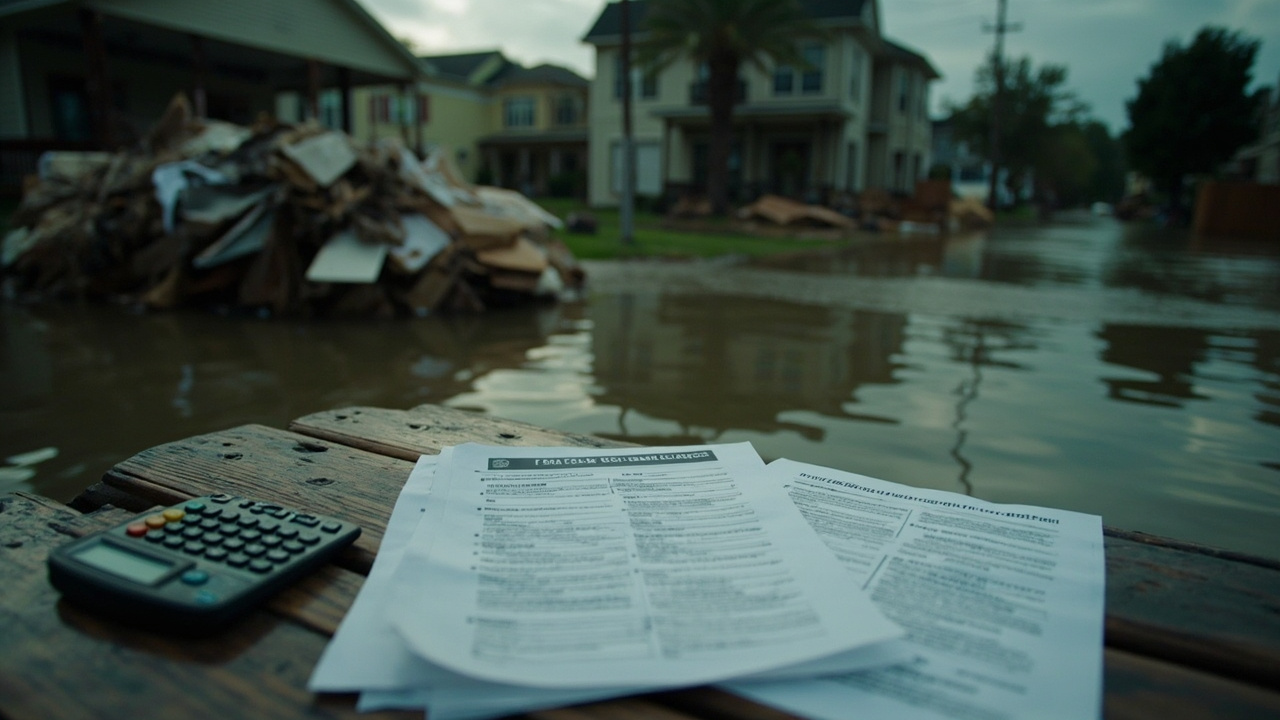
TL;DR: FEMA disaster grants cannot replace flood insurance because assistance requires a presidential declaration, is scoped to basic safety, and averages only a few thousand dollars, while a flood policy pays contracted limits without a declaration.
If your flood plan is "FEMA will help," you do not have a flood plan. Federal help after a flood is conditional, capped, and slow, while a flood insurance contract pays for covered damage whether Washington declares a disaster or not. That distinction is the entire math that households in low-lying neighborhoods, river towns, and hurricane counties need to understand before water enters the house.
Why FEMA help switches on only sometimes
FEMA Individual Assistance does not activate for every flood. It activates only after a presidential major disaster declaration for your area, and most floods never receive one, according to Statewide Flood Insurance in its analysis titled "FEMA Disaster Assistance vs. Flood Insurance: The Real Math."
That limit matters for preparedness. A summer thunderstorm that leaves four feet of water in one subdivision, seepage around a levee, or a flash flood that damages three streets can destroy furnaces, electrical panels, drywall, flooring, cabinets, and appliances. Those losses are personal catastrophes, yet they are often invisible to the declaration process. With no declaration, there is no FEMA grant to request.
A flood insurance policy works differently. It responds to covered flood damage under its own terms, without a declaration, means test, or national news coverage. That independence is why emergency planners treat insurance as a household resilience tool and federal aid as a backup that may never arrive.
Texas in June 2026 shows how selective the declaration system remains. According to the Dick Law Firm analysis titled "Will Texas Flood Victims Get FEMA Assistance?", 10 counties were listed under the major presidential disaster declaration tied to the catastrophic July 2025 flooding across Central Texas: Guadalupe, Kimble, McCulloch, and Menard counties, joining Burnet, Kerr, San Saba, Tom Green, Travis, and Williamson counties.
The same report noted that Harris County, where Houston-area residents were experiencing flooding during the FIFA World Cup period, had not yet received a new disaster declaration. People with damage there were advised to document losses, file insurance claims immediately, and watch for any new declarations as the storm system developed. For a family deciding whether to repair, relocate, or wait, that county-by-county line determines whether a FEMA application is even possible.
The grant is for safety, not rebuilding
Even when a declaration is issued, an Individual Assistance grant is not designed to restore a house. It is scoped to make a home safe, sanitary, and functional, not to return it to its prior condition, according to Statewide Flood Insurance.
Historical average grants after major flood disasters have run in the low thousands of dollars. Set that figure against a flooded first floor: removed drywall, ruined insulation, swollen flooring, damaged wiring, lost cabinets, and failed appliances. A few thousand dollars helps with cleanup and urgent needs, but it does not cover a rebuild.
Washington state's December flooding illustrates the gap between total damage and individual payments. According to News From The States in its report "$11M in federal aid for WA flood victims handed out as deadline passes," published June 16, 2026, more than 1,200 households had received funding, with $11.2 million distributed and more applications still being processed.
Nearly 3,900 homes were damaged in that event. More than 100,000 Washington residents were ordered to evacuate, and hundreds had to be rescued. About half the federal money went toward housing assistance, while the other half was earmarked for other needs such as child care, replacing or repairing personal property or vehicles, and hotel stays. The state estimated total flood damage at $182 million.
The same report said more than 2,500 applications had been filed across 10 counties and many tribal nations ahead of the June 10 deadline, with 19 assistance centers drawing more than 1,000 visits. Washington Gov. Bob Ferguson said he appreciated efforts to spread word about funding and was glad many residents received recovery help. State emergency official Robert Ezelle described a continued full-court effort to process pending applications and thanked FEMA for essential services.
Those numbers are not a criticism of caseworkers. They show structural scale: thousands of damaged homes, tens of millions in community losses, and individual grants that help but do not make households whole.
The biggest federal check is usually a loan
The largest sums available in many federal disaster responses do not come as grants. They come through U.S. Small Business Administration disaster loans, which must be repaid with interest on top of an existing mortgage, according to Statewide Flood Insurance.
That surprise hits families mid-crisis. They expected a grant and learn the main offer creates years of new debt. Flood insurance proceeds work oppositely: they are a contractual payment for covered loss and are never repaid.
Washington again shows the pattern. According to News From The States, the U.S. Small Business Administration had signed off on more than $14 million in low-interest loans to businesses, nonprofits, homeowners, and renters affected by the flooding. That loan total exceeded the $11.2 million distributed at that point in FEMA individual grants. For renters, business owners, and mortgaged homeowners alike, recovery therefore meant either insured payments or borrowed money.
The Dick Law Firm analysis likewise listed FEMA, the State of Texas, and the U.S. Small Business Administration as potential sources for serious disaster-related needs, temporary lodging, basic home repair costs, personal property loss, and disaster loans. Texas Health and Human Services was distributing FEMA-approved relief funds tied to the July 2025 Central Texas flooding, and disaster SNAP food benefits were available. Those programs address immediate hardship, but they do not erase the loan-versus-grant distinction.
What flood insurance actually buys
Standard homeowners insurance does not cover flooding, including storm surge, rising water, and overflow from rivers and drainage systems. A separate flood policy is required, according to LegalClarity in its guide "Hurricane Claims: Insurance Coverage, Filing, and Disputes," published June 17, 2026.
Most residential flood coverage in the United States comes through the National Flood Insurance Program, which provides up to $250,000 for building damage and up to $100,000 for contents on a residential property, according to the same LegalClarity guide. Federal regulation at 44 C.F.R. Section 61.13 establishes the standard policy forms used across the program, including policies serviced through private insurers in the Write Your Own program.
A private or NFIP flood policy pays up to the limits selected for covered damage, whether or not a disaster is declared. For homes valued above the NFIP building cap, excess flood coverage can extend protection toward replacement cost, according to Statewide Flood Insurance. That contract structure is the core preparedness advantage: the payment trigger is water damage to insured property, not a political decision weeks later.
FEMA's Individuals and Households Program can separately provide money for housing repairs, rental costs, and critical personal property replacement, and can fund up to 18 months of temporary housing assistance for homeowners and renters, according to LegalClarity in its guide "Crisis Grants: Eligibility, Amounts, and How to Apply." That temporary housing bridge is valuable during evacuation and repair, but it is not a substitute for building coverage.
The wind-versus-flood trap after hurricanes
Hurricane households face a second coverage split. Homeowners insurance generally handles wind and wind-driven rain, such as shingles torn off and rain entering through the gap. In coastal and hurricane-prone areas, wind may be excluded from the standard policy and require a separate windstorm policy, often through a state-created pool, according to LegalClarity.
Flood and wind damage must then be separated because different policies answer for each. Many homeowners policies contain anti-concurrent causation clauses, which can allow denial of an entire loss if an excluded cause like flooding contributes alongside a covered cause like wind, according to the same source. Courts have split on enforcement, with some allowing separated damage and others applying the exclusion broadly.
That is a pre-storm homework item. Households should read exclusion language, confirm whether wind is included, confirm whether flood is insured at all, and photograph the home's condition before hurricane season. After landfall, adjusters for different policies may dispute the same wall, roof edge, or floor.
Deductibles add another shock. Hurricane deductibles are commonly calculated as a percentage of insured dwelling value, typically ranging from 1% to 10%, rather than as a flat dollar amount, according to LegalClarity. A $400,000 insured home with a 5% hurricane deductible leaves the owner responsible for the first $20,000. Additional living expenses coverage can help with increased costs when a home is uninhabitable, but it covers only the difference caused by displacement, not normal monthly bills.
Most claims come from outside high-risk zones
Flood risk is not confined to mapped high-risk areas. Heavy rainfall, extreme weather, overwhelmed drainage, snowmelt, freeze-thaw cycles, rapid development, and storm surge push water into supposedly safer neighborhoods, according to PIA Northeast News in its June 16, 2026 report "Flood risk reality check."
The scale is national. Flooding accounts for nearly 90% of all natural disaster events in the United States, according to the Federal Emergency Management Agency as cited by PIA Northeast News. Over the past decade from 2014 through 2024, 29% of National Flood Insurance Program claims came from properties outside current high-risk flood areas. Over the past 20 years, 99% of U.S. counties have been affected by flooding.
For preparedness, that means "not in a flood zone" is the start of research, not the end. Households should check current maps, ask an agent how local claims have distributed, review basement and contents limits, and store valuables above expected water lines. Renters need their own contents approach because a landlord's building policy does not replace a tenant's belongings.
How to apply without losing time
FEMA assistance is described as a supplement of last resort, not a replacement for insurance. People with home, health, flood, or auto coverage must file with the insurer first and keep records of payments, according to the Dick Law Firm analysis. Applicants must use available insurance and other help before FEMA's Other Needs Assistance program steps in, and cannot receive that help if they turn down other available assistance.
Texans in designated counties could apply online at disasterassistance.gov or by calling 800-621-3362, with additional counties possible as damage assessments were completed, according to the same source. Survivors without flood insurance faced the harshest gap because individual grants are capped and rarely cover full rebuilding.
Speed matters, but the 2026 system was slower than many expected. The Texas report pointed to an earlier spending rule requiring the Homeland Security Secretary to personally sign off on every contract over $100,000 before funds could be released, which caused critical delays in the earliest hours of the July 2025 disaster. Survivors also faced long helpline waits and difficulty securing post-disaster housing even after designation.
The practical lesson is to run two tracks at once: file insurance immediately and apply for federal help if eligible, without assuming either will move quickly. Keep claim numbers, adjuster names, receipts, moisture logs, cleanup invoices, contractor notes, photos, and videos in one file. Do not discard damaged materials until documentation rules are clear.
A household math checklist for this week
Start with the declaration question. If your street floods without a presidential declaration, federal individual grants are unavailable. Insurance remains available under its contract. That alone reverses the common assumption.
Next, compare limits. A policy offering up to $250,000 in building coverage and up to $100,000 in contents coverage addresses structural repair and belongings in a way that a grant averaging a few thousand dollars cannot. Households above those caps should ask about excess options before storm season.
Then price the loan risk. An SBA disaster loan adds repayable debt to a mortgaged home. Insurance proceeds do not. A family carrying a mortgage, car payment, and childcare costs should understand which path adds monthly obligations during displacement.
Finally, close the wind and flood gap. Confirm wind coverage, flood coverage, hurricane deductible percentage, temporary housing terms, and proof-of-loss deadlines. Store policy numbers outside the house, keep a go-bag with documents, and plan where the family will stay if the first floor becomes uninhabitable. Preparation does not prevent water, but it prevents the second shock of learning the math after the flood.
Sources referenced
- FEMA Disaster Assistance vs. Flood Insurance: The Real Math - Statewide Flood Insurance (https://statewidefloodinsurance.com/fema-disaster-assistance-vs-flood-insurance/)
- $11M in federal aid for WA flood victims handed out as deadline passes - News From The States (https://www.newsfromthestates.com/article/11m-federal-aid-wa-flood-victims-handed-out-deadline-passes)