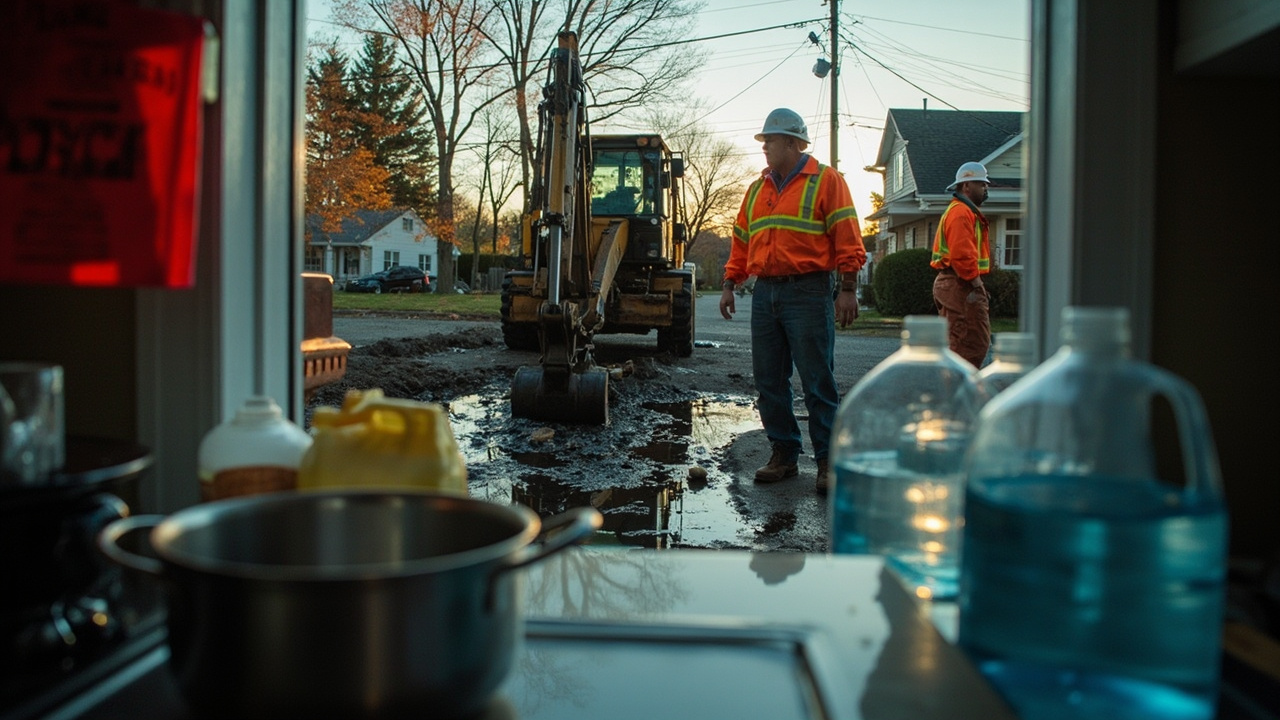
TL;DR: A precautionary boil-water advisory covers part of Washington Township in Lucas County, Ohio, after water main breaks near Shoreland and Summit, and homes and businesses in the mapped area should boil tap water for at least one minute or switch to bottled water until the county lifts the notice.
The Lucas County Sanitary Engineer's Office issued the advisory Friday morning, Nov. 20, 2026, WTOL 11 reported at 10:55 a.m. Eastern. The notice covers a portion of the township, according to WTOL 11. Reporting published Saturday, Nov. 21, by The Lake Erie Inquiry still described the advisory as in effect.
Water for consumption should be boiled for at least one minute before use, or replaced with bottled water, according to WTOL 11. 13abc (WTVG) reported the same instruction for residents near Shoreland and Summit, with the advisory set to last until official lab tests come back.
Three breaks, then a fourth
A Lucas County spokesperson told 13abc on Friday morning that the Sanitary Engineer's Office was working to repair three water main breaks around Shoreland and Summit. The township reported an additional break there Friday evening, 13abc said — a fourth break in the same area.
The advisory went out while crews were still working. The county said the notice would stay until laboratory results were obtained, and it told households and businesses to plan for at least 72 hours, WTOL 11 reported.
The streets inside the boundary
The county's map, released Nov. 20, marks Jasik, Holliday, Randon, Capshore, Capri and Shoreland, east of Summit Street, The Lake Erie Inquiry reported, citing the Board of Lucas County Commissioners' news release and map. Homes and businesses on those streets were advised to boil water for drinking and food preparation for at least one minute, with bottled water as an alternative.
The county's map defines the area covered, and the same instruction reaches commercial addresses inside it, WTOL 11 reported. The county said it would issue a notice when the advisory is lifted; The Lake Erie Inquiry's Saturday report said the advisory remained in place.
What to do with tap water now
- Boil it. Heat drinking water to a boil and keep it boiling for a full minute, the instruction WTOL 11 and 13abc reported. Ready.gov calls boiling the safest way to treat water and calls for a rolling boil lasting one full minute, then cooling before drinking.
- Or use bottled. Bottled water is the alternative the county's notice names, per WTOL 11.
- Flush the lines first. The City of Toledo's boil-advisory page says to flush household pipes by running cold taps before using water for drinking or cooking.
- Treat every use alike. Toledo's page names drinking water, baby formula, ice, tooth-brushing, dishwashing and food preparation as uses that should rely on boiled or bottled water until the advisory ends.
- Wait for the lift. Toledo's page says households can go back to normal use when the advisory ends, provided the system has not extended it.
Why a break brings a boil notice
Toledo's advisory page says broken and repaired water lines account for most advisories, with a major pressure drop as another cause. The aim is protection from possible contamination when a main cannot hold adequate pressure.
Ohio EPA's disruption-of-service rule sets the state framework. It defines a disruption as pressure falling below 20 psig at ground level anywhere in the distribution system, and for the more serious incident categories it lists a precautionary advisory for affected customers and special coliform sampling after repairs among the required responses. Lucas County's notice ties the lift to lab results rather than to the repair schedule.
The 72-hour clock
Seventy-two hours is the planning window the county gave homes and businesses, and it is a minimum rather than an end time. The advisory does not expire on its own at that mark. It ends when the Sanitary Engineer's Office announces it has been lifted, the step WTOL 11 and 13abc both described. Questions go to that office at 419-213-2926, the number WTOL 11 and The Lake Erie Inquiry listed.
Sizing a household water supply
Two federal agencies publish storage benchmarks. Ready.gov's storage benchmark is a gallon per person each day, held for several days, to cover drinking and sanitation. The agency notes that households with children, nursing mothers or ill members may need a larger buffer, and that hot weather can double the requirement. It also puts a normally active person's daily fluid need at roughly three-quarters of a gallon, counting water and other drinks. The CDC's baseline is a three-day supply sized at a gallon per person daily, with two weeks stored when possible. The CDC says sealed, store-bought bottled water is the most dependable choice in an emergency and should be used for drinking, cooking and brushing teeth.
Ready.gov says commercially bottled water should stay sealed in its original container in a cool, dark place, and that home-filled containers need fresh water every six months; the CDC gives the same replacement interval. For home-filled containers, Ready.gov says to use food-grade storage containers, and the CDC says containers once used for toxic chemicals, bleach or pesticides should not be reused. Before filling, the CDC lists a cleaning routine: wash with soap and rinse, sanitize with a bleach solution, shake, wait at least 30 seconds, empty and air-dry. If water looks cloudy before treatment, Ready.gov suggests settling out suspended particles or filtering them through cloth or a coffee filter, and it says pouring cooled boiled water between two clean jugs improves the taste. Ready.gov also says households should not ration drinking water unless officials direct them to.
After the all-clear
Toledo's page says households can return to normal use when the advisory ends if the system has not extended it. It advises holding off on laundry and hot-water use if the water is tinted, and running cold taps until it clears.
The lift notice is the signal to resume normal use; until the county posts it, the boil-or-bottle rule and the mapped boundary remain in force.