TL;DR: Federal emergency aid approved for Orange County chemical response
TL;DR: President Donald Trump approved California's request for a Presidential Emergency Declaration on May 25, 2026, authorizing FEMA direct federal assistance for Orange County's Garden Grove chemical response.
Governor Gavin Newsom announced the approval on May 25, 2026, to support ongoing emergency operations tied to the chemical incident in Garden Grove, according to the Governor of California. The action authorizes the Federal Emergency Management Agency to provide personnel, equipment and other specialized resources to support life-saving response.
The declaration covers emergency conditions resulting from a chemical release beginning May 21, 2026, and continuing, according to FEMA.gov. The assistance is for Orange County and is limited to direct federal assistance for emergency protective measures under the Public Assistance program at 75% federal funding.
More than 785 state and local emergency personnel continue working around the clock to protect impacted communities, according to the Governor of California. The personnel include firefighters, law enforcement officers, hazardous materials experts, public health officials, transportation crews, environmental scientists and emergency coordinators working 24/7 alongside local agencies.
Explosion risk eased but evacuations remain
Overnight, the Orange County Fire Authority confirmed that the risk of a massive explosion from the damaged methyl methacrylate tank has been mitigated, according to the Governor of California. Emergency officials warned that significant public health and environmental risks remain and evacuation orders continue to be in place.
The risk of a catastrophic explosion was eliminated following a close overnight inspection that confirmed a crack in the tank relieved pressure and cooled the chemical, according to the Associated Press. The results of the evaluation was described as incredibly positive news by Orange County Fire Authority Division Chief Craig Covey, who said officials could turn the corner after days of concern about a possible explosion.
Evacuation orders remained in place for about 50,000 people in Garden Grove, located south of Los Angeles, according to the Associated Press. There had been no chemical leak as of early Monday, but the Orange County Fire Authority said the risk to public safety is ongoing.
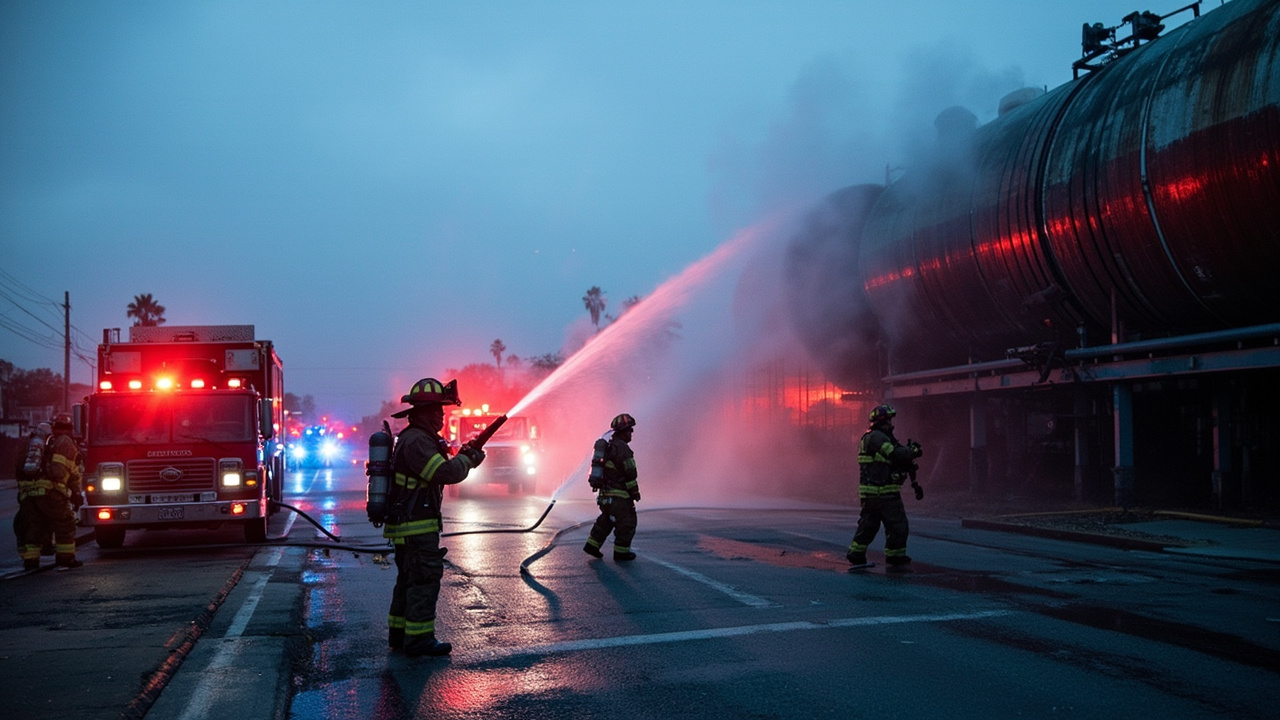
The tank interior had cooled to 93 degrees F, or 33.9 degrees C, down from 100 degrees, or 37.7 degrees Celsius, on Sunday, according to the Associated Press. After the tank overheated Thursday and began venting vapors, firefighters repeatedly sprayed the tank with water in an attempt to cool the methyl methacrylate inside.
What happened at the Garden Grove site
The tank is at a site owned by GKN Aerospace Transparency Systems, which makes cockpit windows, canopies and windshields for military and commercial aircraft, according to the Associated Press. The tank holds 6,000 to 7,000 gallons, or 22,700 to 26,500 liters, of methyl methacrylate used to make plastic parts.
Methyl methacrylate converts from a liquid to a gas and increases pressure as interior temperature rises, according to Purdue University engineering professor Andrew Whelton, as reported by the Associated Press. The chemical is identified as methyl methacrylate, also referred to as MMA, in state and federal incident descriptions.
GKN Aerospace, a British industrial company, employs about 16,000 people across 32 manufacturing sites in 12 countries and supplies technologies and components used by major commercial and military aircraft manufacturers worldwide, according to the Associated Press. It remained unknown when the operation would reopen.
Disruptions at facilities producing specialized aircraft components can be difficult for the global aerospace industry to absorb because supply chains are highly concentrated globally and already strained, said Richard Aboulafia, managing director of aerospace consulting firm AeroDynamic Advisory, as reported by the Associated Press. Aboulafia said aerospace manufacturing differs from many other industries because aircraft production rates are relatively low, leaving only a small number of suppliers for many specialized parts and systems.
What the Emergency Declaration authorizes
The federal Emergency Declaration allows FEMA to provide direct federal assistance with personnel, equipment and other specialized resources to support life-saving response, according to the Governor of California. FEMA announced that federal disaster assistance is available to the State of California to supplement response efforts due to the emergency conditions, according to FEMA.gov.
The President's action authorizes FEMA to coordinate all federal disaster response efforts to alleviate hardship and suffering caused by the emergency and to provide appropriate assistance to save lives, protect property, public health and safety and lessen or avert the threat of a catastrophe, according to FEMA.gov. Specifically, FEMA is authorized to identify, mobilize and provide, at its discretion, equipment and resources necessary to alleviate the impacts of the emergency.
Mark O'Hanlon has been named the Federal Coordinating Officer for federal response operations in the affected areas, according to FEMA.gov. Designations may be made at a later date if requested by the state and warranted by the results of further damage assessments.
Unlike a Presidential Major Disaster Declaration, which is typically approved only after significant damage has already occurred, an emergency declaration is focused on immediate response and protective actions, according to the Governor of California. The key distinction lies in timing, scope and assistance: emergency declarations are issued during or in advance of an incident to prioritize immediate life-safety measures, while major disaster declarations occur after damage assessments to unlock broader, long-term recovery programs and individual assistance.
State actions before the federal approval
On Friday, Governor Newsom proclaimed a State of Emergency for Orange County and activated the State Operations Center, directing state agencies to coordinate rapidly with local officials to support response and recovery operations, according to the Governor of California. The state request for an Emergency Declaration was submitted last night before the May 24, 2026, announcement, according to the Governor of California.
California mobilized more than 785 state and local first responders and emergency personnel over the course of the response, according to the Governor of California. The coordinated whole-of-government response was described as intended to protect residents, support evacuations, monitor environmental conditions and assist Orange County communities impacted by the incident.
State actions included activating the State Operations Center and deploying mutual aid resources, according to the Governor of California. The state pre-positioned emergency personnel, including fire, law enforcement and medical teams, and coordinated with Orange County officials to support evacuations, traffic management and public information.
The state staged critical supplies and equipment in the region to accelerate response timelines, according to the Governor of California. The state also provided the public with information on the health impacts of methyl methacrylate and engaged state agencies to ensure continuity of essential services and infrastructure protection.
The California Governor's Office of Emergency Services continues to work closely with FEMA, local partners and state agencies to monitor conditions and adjust response efforts as needed, according to the Governor of California. Governor Gavin Newsom said: “California didn’t wait for this situation to escalate — we moved early, aggressively, and in close partnership with local responders to protect lives and support impacted communities.”
Household guidance for residents near the incident
Residents are urged to continue following local emergency guidance and evacuation orders while response operations continue, according to the Governor of California. Evacuation orders are in place for safety, and residents told to evacuate are instructed not to wait.
Individuals outside evacuation zones do not need to take additional precautionary measures at this time, according to the Governor of California. Residents are instructed to stay away from the incident area and not to attempt to observe response operations in person.
Residents are urged to check on neighbors, older adults and others who may need assistance accessing transportation, sheltering or medical support, according to the Governor of California. Californians should rely on trusted information from local emergency officials and public health agencies, not rumors or social media speculation.
Visit the City of Garden Grove website to view an evacuation map, according to the Governor of California. Resources and other useful information for those affected by the Garden Grove Hazmat Incident can be found on the Cal OES Community Resource page.
Residents are urged to listen to local officials for the latest evacuation information, according to the Governor of California. The state directed residents to find city emergency updates at linktr.ee/cagovernor.
How families can track aid and next steps
Federal cost-share support covers urgent, life-saving and life-sustaining actions including evacuations, sheltering, emergency medical support and other protective operations, according to the Governor of California. Access to Public Assistance for emergency protective measures helps pay for overtime, equipment and emergency actions local agencies must take to keep people safe.
The declaration enables FEMA to provide additional direct federal assistance such as personnel, specialized equipment and technical support that can plug directly into the state and local response in Orange County, according to the Governor of California. Because California requested the Emergency Declaration early, federal support can flow while the incident is still unfolding rather than waiting until the full extent of damage is known.
This type of declaration is specifically designed to enable proactive, forward-leaning response, helping communities prepare for and mitigate impacts as an incident unfolds, according to the Governor of California. Emergency declarations prioritize short-term response and life safety measures, while major disaster declarations may provide Individual Assistance for residents and Public Assistance for permanent repairs.
These types of longer-term assistance were not included in the emergency request and would need to be requested later, if legally supported, depending on the scope and severity of the incident, according to the Governor of California. The FEMA release carries Release Number HQ-26-063 and a release date of May 25, 2026, according to FEMA.gov.
Sources referenced
- Governor of California - Governor Newsom secures Presidential Emergency Declaration approval for Orange County hazmat response (https://www.gov.ca.gov/2026/05/25/governor-newsom-secures-presidential-emergency-declaration-approval-for-orange-county-hazmat-response/)
- FEMA.gov - President Donald J. Trump Approves California Emergency Declaration (https://www.fema.gov/press-release/20260525/president-donald-j-trump-approves-california-emergency-declaration)