TL;DR: Maui County faces roughly $100 million in unbudgeted Kona Low repairs across 92 sites while household aid windows stay partly open.
Members of the Maui County Council's Disaster Recovery, International Affairs and Planning Committee were told Wednesday that estimated damage from the March Kona Low storms has reached roughly $100 million, according to Maui Now reporting published June 19, 2026.
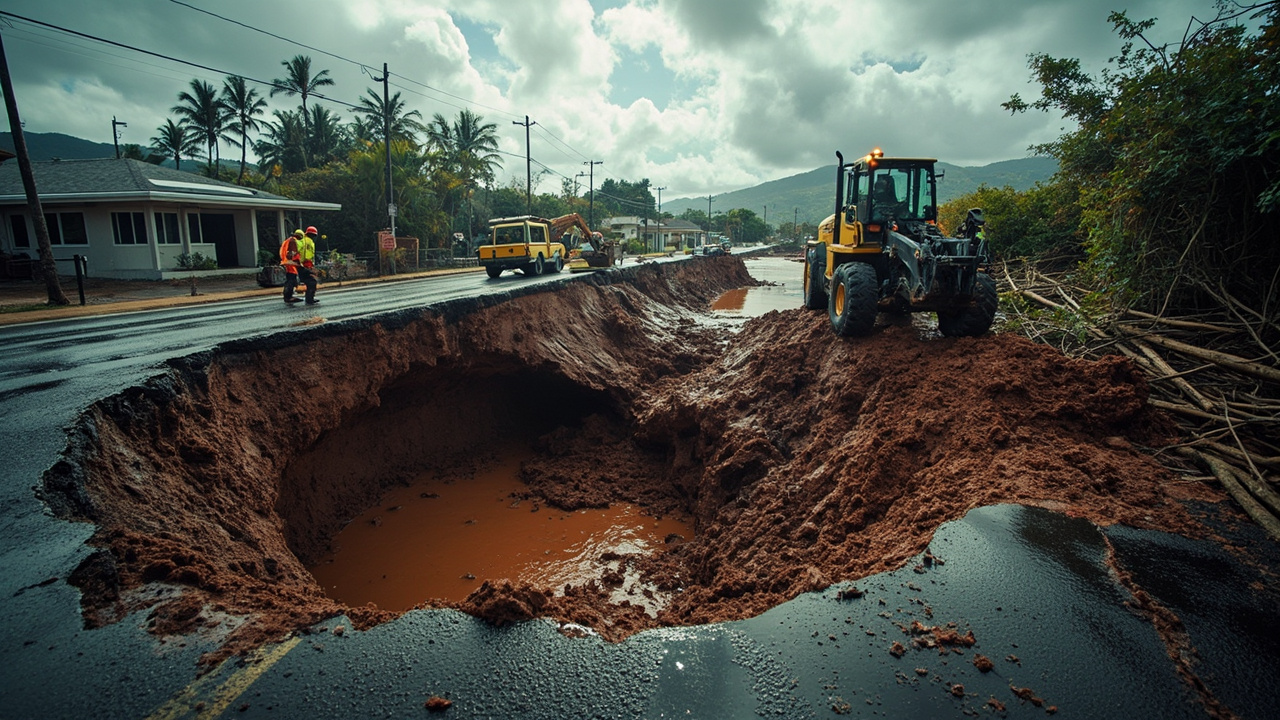
Office of Recovery Administrator John Smith displayed a slide showing the $100 million-plus Kona Low recovery and mitigation cost landing on top of $2.36 billion in wildfire recovery and mitigation needs, for a total of $2.47 billion in infrastructure and recovery needs so far. A Department of Water Supply repair crew worked Tuesday to repair a waterline wiped out in March Kona Low flooding that left a gaping sinkhole on South Kīhei Road.
For households, the lesson is financial as well as physical: the county must pay for repairs up front and then seek reimbursement through an extensive application, review and reporting process. Residents face a parallel process with the Federal Emergency Management Agency and the U.S. Small Business Administration, where the June 14 registration deadline has passed but late requests and grace-period loans remain available for some applicants.
A $100 million bill that was not in the budget
Smith told council members the $100 million Kona Low damage was not really budgeted in the $1.6 billion fiscal year budget passed on second and final reading June 5, according to Maui Now.
He said a later update in the fiscal year would clarify how much of that $100 million would land in fiscal 2027 or possibly become a fiscal 2028 project. The timing matters for preppers because public repairs to roads, waterlines, storm drains and flood channels will stretch across more than one budget cycle.
Smith said Maui County must pay for repairs up front and then seek reimbursement from the federal government, from agencies such as the Federal Emergency Management Agency, after going through an extensive application, review and reporting process. Typically, the federal government reimburses 75% of costs while the county pays for the remaining 25%.
In response to a question from Council Member Keani Rawlins-Fernandez, Smith said he does not believe FEMA helps pay for debt service on bond-funded projects. He added that staff could follow up, phrasing his answer as his current understanding rather than a final determination.
The exchange highlights a household parallel: borrowing to repair a home quickly does not guarantee that interest or financing costs will be covered by later aid. Residents who use credit or loans for emergency repairs should keep receipts, loan statements and contractor invoices separate from grant applications.
92 county sites damaged across Maui and Molokaʻi
Smith reported Kona storm damage to 92 county-owned infrastructure sites spanning East, West, Central and South Maui, Upcountry and Molokaʻi, according to Maui Now.
During his presentation, Smith showed council members a map with damage sites. Every circle represented damaged infrastructure owned by the county, and the larger the circle, the more extensive the damage.
Smith emphasized that the damage was widespread. He said that when the storms hit, it impacted all of Maui very significantly and left sinkholes in many places.
Significant damage included the Central Maui Landfill, where flood waters tore apart some walls that have since been repaired. Homes were flooded and damaged in Hāna, Molokaʻi and ʻĪao Valley, where extensive rain and flooding were comparable with the inundation there in 2016.
Smith said Kīhei was overwhelmed with sediment and debris, along with sinkholes and other issues associated with roadway and infrastructure failures. For family readiness, the pattern shows that flood risk was not limited to one valley or coastline.
Households near gulches, low roads, landfill access routes and previously flooded valleys should plan for road closures, detours and delayed trash, water and emergency-vehicle access after intense rain.
Kula Gym appears to be a total loss
The Kula Upcountry Gym appears to be a total loss and likely cannot be repaired, Smith said. A structural engineer's evaluation is expected within 60 days.
In 2016, Maui County purchased the Kula Gym in Waiakoa for $1.2 million, after leasing it for 46 years. The history shows how a long-used community shelter, gym and gathering place can be removed from local capacity by one storm season.
Families that relied on a school gym, church hall or community gym as a backup meeting point should identify a second location. Do not assume a familiar public building will be open, dry or structurally cleared after flood damage.
For assistance approved so far from FEMA in Maui County, 737 applications for $4.25 million were approved for individuals and households, according to figures Smith presented. Another 249 applications for $2.23 million were provided in housing assistance, and other needs assistance was granted to 737 applicants amounting to $2 million.
Those county-level totals describe approvals reported to the committee, not the statewide program. They show that separate categories exist for housing repairs, temporary housing and other needs, and that documentation and eligibility differ by category.
South Kīhei Road: water main, storm line and roadway sequence
The South Kīhei Road sinkhole remains one of the most significant ongoing challenges. Smith explained that the failure began with a water main break that storm runoff and ocean surge then overwhelmed, worsening the damage.
Repair crews have since replaced the water main. Officials expect crews to complete storm line repairs within two weeks, after which workers will install engineered geotextile reinforcement under the roadway.
The sequence is a preparedness lesson for drivers and South Maui households. A visible sinkhole repair is not only a paving job. Water service, storm drainage and roadbed stabilization must happen in order, which extends closures.
Meanwhile, roughly 300,000 cubic yards of sediment has accumulated in Kīhei's gulches, primarily Kūlanihākoʻi, Waipuʻilani and Waiakoa. Smith described the volume as the equivalent of several football fields stacked 100 feet high.
As a frame of reference, officials estimated the amount of debris from the West Maui wildfire at 400,000 cubic yards. Maui County has applied for a U.S. Department of Agriculture Emergency Watershed Protection Program grant of more than $20 million to fund removal.
Until gulches are cleared, nearby residents should expect reduced channel capacity during later rain. Keep storm drains near the home clear of leaves and trash, know where uphill water enters the street, and avoid driving through flooded dips where the roadbed may be undermined.
SBA grace period runs through Aug. 13
Elizabeth Vargas, public affairs specialist for the U.S. Small Business Administration, told committee members that while the initial loan application deadline of June 14 has passed, a 60-day grace period allows homeowners, renters, businesses and nonprofits to submit late applications through Aug. 13, according to Maui Now.
Economic injury loans for businesses and nonprofits remain open until Jan. 7. Vargas said SBA offers disaster loans to homeowners and renters, besides businesses, noting that many residents remain unaware of this eligibility.
She said there is no cost to apply, no prepayment penalty, and no obligation to take a loan if approved. Vargas confirmed that SBA representatives visited Molokaʻi last week and will return as needed.
For East Maui residents who lost power and food during the storms, Smith and Vargas clarified that residents should direct food losses to FEMA. The distinction matters because households often apply to the wrong program first and lose time gathering the wrong forms.
FEMA late applications considered case by case
Although the deadline to apply for FEMA Individual Assistance for the March 10-24, 2026 Kona Low flooding has passed, FEMA and its partners say support continues and, in some circumstances, late applications may still be considered, according to KWXX reporting published June 18, 2026.
Impacted residents in the City and County of Honolulu, and Hawaiʻi and Maui counties who missed the June 14 registration deadline may still be able to apply if they can show good cause for not applying on time. Examples may include serious illness or hospitalization, extended displacement or limited access to communications, and other significant barriers that prevented timely registration.
Late registrations are considered case by case and are not guaranteed. To request consideration, applicants are asked to call the FEMA Helpline at 1-800-621-3362, explain why they were unable to apply before the deadline, and be prepared to provide any supporting information FEMA may request.
FEMA will review each request under applicable policies and notify applicants of the decision. Households should call promptly, write down the date, representative name and instructions received, and keep medical, shelter, hotel, utility-outage and phone-service records that support the reason for delay.
What Otake Camp shows about night flooding
At Otake Camp in Waialua, residents said facing a wall of water during the March Kona low floods made survival difficult and escape urgent, according to Hawaii News Now reporting published June 18, 2026.
More than 5,500 North Shore residents were evacuated as severely saturated ground could not absorb more rain. Mount Kaʻala received 22 inches of rain, acting as a funnel that sent high-velocity runoff into basins below.
One resident said it was 11:30 at night and the household was already on flood watch because of prior flooding. A son woke his mother to say the water level was at the berm along Kaukonahua Stream, and the family decided to leave immediately.
Family members walked out with whatever they had, with some wearing shoes and others barefoot, and knocked on walls to wake neighbors. They described digging feet into the ground, pulling against the current, carrying children above their heads, staying together as a group, and meeting first responders during the exit.
By the time help arrived, floodwaters had surpassed six feet, filling homes inside and out. One evacuee, who is 5 feet 11 inches tall, said water reached shoulder height during the evacuation of others.
Residents said sirens did not sound there that night, while first responders faced a large volume of calls. In a recent University of Hawaiʻi study, researchers found that two trillion gallons of water flooded the islands during the event, enough to fill three million Olympic-sized swimming pools.
Three Otake Camp plantation houses were ripped from their foundations and carried down the river, displacing six families. One survivor described the loss of valuables, mementos, photos and childhood keepsakes in minutes.
Another resident said, "You're not thinking what to grab. You're thinking who to grab." One displaced resident has spent about two months living in a donated food truck outfitted with a bed.
Household checklist drawn from these cases
Decide evacuation triggers before nightfall when streams are rising and flood watches are in effect. The Otake Camp accounts show that waiting for sirens or daylight can leave too little time when a berm is overtopped and water rises past six feet.
Keep shoes, flashlights, medications, phone chargers, children's supplies and vehicle keys where they can be grabbed without searching. Some residents left barefoot with only what they were carrying.
Plan for vertical and neighbor help: wake vulnerable neighbors, move as a group, and carry small children above water. Avoid walking or driving through fast current, and turn back if footing is lost.
Separate aid paperwork by program. Direct housing, temporary rental and other-needs requests through FEMA channels, food-loss questions to FEMA as instructed at the Maui meeting, and repair or personal-property loan options through SBA while the grace and economic-injury windows apply.
Photograph flood lines inside and outside the home, damaged appliances, flooring, walls, vehicles and food spoilage before cleanup. Keep contractor estimates, water-utility notices, shelter letters and medical records together for late FEMA review or SBA loan review.
Sources referenced
- Kona Low storm damage estimated at nearly $100 million : Maui Now (https://mauinow.com/2026/06/19/kona-low-storm-damage-estimated-at-nearly-100-million/)
- Kona Low Help Continues After Registration Deadline | KWXX - Hilo, HI (https://www.kwxx.com/2026/06/18/kona-low-help-continues-after-registration-deadline/)