TL;DR: Homeowners and renters in Honolulu, Hawaiʻi County and Maui County with March 10–24, 2026 Kona Low flood damage can seek FEMA grants and SBA low-interest loans, but must apply by Sunday, June 14, 2026.
Residents whose primary home was damaged by flooding during March 10–24, 2026 may qualify for federal help if the address is in the City and County of Honolulu, Hawaiʻi County or Maui County, according to FEMA's Frequently Asked Questions: FEMA Assistance for Residents Impacted by March Kona Lows.
That FEMA fact sheet, released May 29, 2026, describes Individual Assistance as direct financial support for eligible owners and renters whose main residence suffered disaster harm.
The program addresses basic, essential recovery needs that insurance or another source has not paid, and it does not substitute for insurance coverage.
Who can request Individual Assistance
Eligibility centers on four tests outlined by FEMA.
The applicant’s main home must sit in one of the three declared areas: City and County of Honolulu, Hawaiʻi County, or Maui County.
The household must show disaster-linked damage or loss tied to the March 10–24 Kona Low flooding.
Losses that already received full payment from insurance or other sources do not qualify for duplicate payment.
The request must arrive by the June 14, 2026 cutoff.
According to the Maui Recovers news report titled Two weeks left to apply for FEMA Individual Assistance and Small Business Administration low interest loans, dated June 1, 2026, homeowners, renters and businesses with property damage or losses from the March Kona Low flooding have two weeks remaining from that date.
That report states Sunday, June 14, is the final day to seek both FEMA disaster assistance and U.S. Small Business Administration low-interest physical property damage loans, while requests already started will not be affected by the cutoff.
Housing help for owners and renters
FEMA groups housing support into short-term lodging and repair categories.
Temporary Housing Assistance serves both owners and renters when a disaster leaves a home unsafe, unsanitary or not functional.
In that situation, the agency may provide money to cover a short-term rental.
Households that paid for a hotel because of the disaster may receive lodging-expense reimbursement.
Home Repair Assistance is limited to owners and concerns disaster-linked harm to the primary residence.
Repairs aim to restore a safe, sanitary and functional condition, not to fund upgrades.
Covered work can involve electrical, plumbing and heating systems.
It can also involve structural components, including foundation, roof and walls.
Essential living spaces — kitchen, bathroom and sleeping areas — fall within the scope.
Other Needs Assistance beyond the structure
Beyond housing, Other Needs Assistance may pay certain necessary disaster-linked costs, FEMA explains.
Personal-property help can cover essential household goods such as beds, furniture, appliances and some clothing.
Transportation help can pay to fix or replace a vehicle harmed directly by the Kona Low flooding.
Medical and dental help can address certain disaster-caused or disaster-worsened health costs, including injury care and replacement of damaged medical equipment.
Child-care help can address some new or added child-care spending connected to the disaster.
Additional eligible spending can include some cleanup items and other necessary expenses.
What Individual Assistance will not pay
FEMA lists four exclusions households should understand before applying.
It will not pay losses already fully covered by insurance or another source.
It will not cover business-linked losses, including forgone income or harm to business property.
It will not pay for harm to secondary or vacation houses.
It will not pay for repairs unrelated to the disaster or for long-standing maintenance problems.
Insurance comes first
Insurance remains the primary recovery funding source in the FEMA framework.
Policyholders should submit insurance claims as soon as possible.
FEMA cannot duplicate an insurance payment, but it may address unmet need when a policy omits some damage or when a claim receives a partial denial.
Applicants will face questions about insurance coverage during the FEMA process.
A household with a pending claim should still file with FEMA, then supply settlement documents or denial letters upon receipt.
FEMA will examine what insurance paid before deciding what FEMA may supply.
According to KHON2's report titled Loans up to $2 M available for those impacted by Kona low, applicants in the loan process can also pursue insurance while their federal file remains active.
That report quotes U.S. SBA public affairs specialist Africa Rosas saying, “Once they are in the system, they have six months to think about it.”
The same report quotes Rosas adding that people can claim with insurance and seek funds elsewhere while remaining in the SBA process, with approved money held for six months.
What to gather before filing
Having details ready can accelerate review, although FEMA states that residents need not hold every document to begin.
Applicants should prepare current contact details, including phone number, mailing address and email where available.
They should provide the address of the damaged primary residence.
They should provide a Social Security number.
They should list insurance details, including policy numbers and company names.
They should write a brief account of damage and losses.
Those selecting direct deposit for any approved payment should supply bank account and routing numbers.
Complete and accurate information reduces delay risk.
Four ways to file with FEMA
Maui Recovers lists four filing routes that remain open through June 14.
Households can file online at DisasterAssistance.gov.
They can file through the FEMA App.
They can call the FEMA Helpline at 800-621-3362, with relay-service users asked to share their service number, support offered in multiple languages, and lines staffed 24 hours per day, seven days per week.
They can visit a Local Recovery Center, with locations listed at Ready.Hawaii.Gov.
For an American Sign Language guide on filing, the county points to the video FEMA Accessible: Three Ways to Register for FEMA Disaster Assistance.
After filing: inspection and decision letter
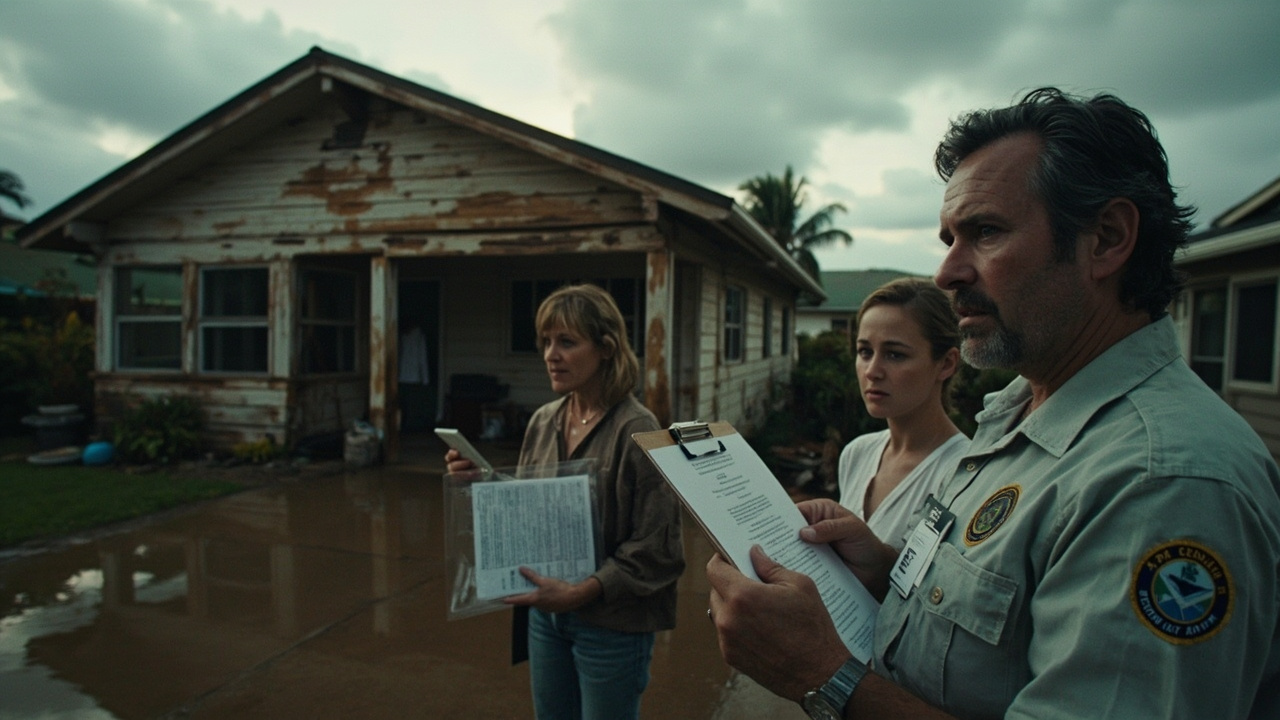
Applicants who reported serious home damage may receive a call to arrange an inspection visit.
Inspectors show official FEMA identification, never request money, and record disaster-linked damage.
Because inspectors may call from an unfamiliar number, FEMA urges applicants to answer and maintain contact to prevent processing delays.
Anyone who hears nothing about an inspection or encounters inspection problems can call the FEMA helpline at 1-800-621-3362.
FEMA then mails a decision letter describing what aid was or was not approved and the reason.
Recipients who disagree may appeal within 60 days of the date printed on the decision letter by submitting a written explanation plus supporting documents.
FEMA notes that many files need only minor updates to reach eligibility.
SBA low-interest disaster loans
A separate federal loan channel runs on the same June 14 physical-damage deadline.
KHON2 reports that the U.S. Small Business Administration offers disaster loans up to $500,000 for homes and $2 million for businesses and nonprofits.
Payment is not required during the first 12 months after distribution, and interest does not accrue during that period, according to that reporting.
Rosas is quoted saying, “And the best part of all, they don’t need to repay them for up to a whole year after they receive the money, and the interest doesn’t accrue during that time.”
The same specialist described the loans in that report as, “These loans are a lifesaver for some small business owners that had to close for a month.”
The report adds that the first year carries no interest and no early-payment penalty.
Starting rates cited are 2.875 percent for home loans, 4 percent for business loans and 3.625 percent for nonprofit organizations.
Maximum amounts listed are $100,000 for personal property, $500,000 for primary residences and $2 million for businesses and nonprofits.
Applicants generally learn within about a week whether they qualify and for what sum, according to Rosas in the KHON2 account.
How and where to seek an SBA loan
Filing is free, and Maui Recovers lists five access points.
Applicants can file online at sba.gov/disaster.
They can call the SBA Customer Service Center hotline at 800-659-2955, while people who are deaf, hard of hearing or have a speech disability may dial 711 for relay.
They can email [email protected].
They can visit a Local Recovery Center, found through Ready.Hawaii.Gov.
They can visit a Disaster Loan Outreach Center to submit a finished application or obtain in-person help, with locations searchable at Appointment.sba.gov.
KHON2 names four in-person outreach sites.
In Hawaiʻi County, sites include the Hawaiʻi County Office of Aging Conference Room at 1055 Kinoole Street, Suite 101, and Hanama Place at 75-5706 Kuakini Highway, Suite 101.
In Honolulu County, the site is Waialua United Church of Christ at 67-174 Farrington Highway.
In Maui County, the site is Kihei Public Library at 35 Waimahaihai Street.
Language access and local information points
Language support is a distinct preparedness issue for Honolulu-area households, according to the Honolulu Star-Advertiser report Kokua Line: Must I speak English to get FEMA aid?
That May 31, 2026 column states that Honolulu’s Office of Economic Revitalization posts disaster-aid details in 15 languages on the homepage of revitalizeoahu.org.
It states that translated materials are also linked on ready.hawaii.gov, the site of the Hawaiʻi Emergency Management Agency, and, less prominently, on oneoahu.org, the city site focused on Kona-low recovery.
Federal aid information is available by phone in many languages at 800-621-3362, where callers hearing the recorded greeting press 1 for English, 2 for Spanish or 3 for other languages.
Honolulu’s Pacific Gateway Center provides interpretation and translation in more than 35 languages for community needs involving health, education, social services, legal matters and government documents, according to that column’s description of pacificgatewaycenter.org.
The same column notes that eligibility requires the applicant to be a U.S. citizen, noncitizen national or qualified alien whose identity can be verified through public records, citing FEMA’s website.
Survivors seeking case updates can call the FEMA Helpline at 1-800-621-3362, visit a local recovery center staffed by FEMA personnel with locations at Ready.Hawaii.Gov, or review FEMA letters and online notices at DisasterAssistance.gov.
Relay-service users, including video-relay or captioned-telephone users, should give FEMA the number for that service when calling.