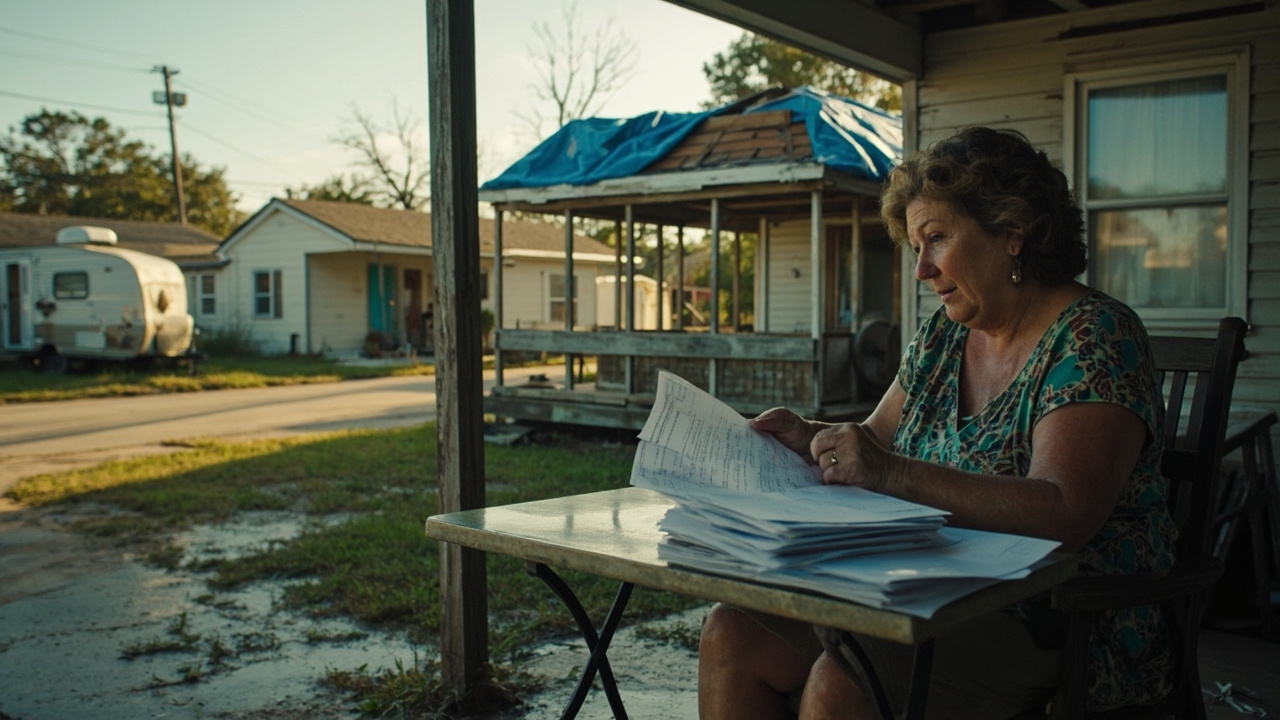
Lower-income families, households of five or more, mobile-home and travel-trailer residents, and people in census tracts with higher shares of minority households waited longer for FEMA housing aid after Hurricane Ike, according to a Natural Hazards Center research abstract on the 2008 Texas disaster. The abstract describes a Texas A&M University poster that used applicant-level OpenFEMA data and records from a Freedom of Information Act request. It says the uneven speed of funding disbursements may deepen existing vulnerabilities. FEMA's Nov. 6, 2026 Federal Register notice set the maximum Individuals and Households Program award at $46,400 for housing assistance and $46,400 for other needs assistance for disasters declared on or after Oct. 1, 2026, and GAO reported in April 2026 that survivors still faced long helpline waits and housing obstacles.
What the Ike study measured
Hurricane Ike made landfall in September 2008 and caused extensive damage along the Texas coast; the poster says the storm's large surge devastated Galveston. Michelle Stanley and colleagues at Texas A&M University's Hazard Reduction and Recovery Center produced the poster. They built the analysis around FEMA's Individual Assistance program, which includes the Individuals and Households Program. Housing Assistance grants cover rent, repairs and replacement.
The researchers modeled three groups of variables: hazard exposure, household characteristics and neighborhood race and ethnicity. They tested whether those factors affected how long homeowners and renters waited for assistance for home repairs, home replacement or rent. The abstract says empirical evidence on the timing of housing assistance has been limited.
Which households waited longer
The abstract's summary is specific: hardships may be particularly compounded for lower-income families, larger households, residents of mobile homes and travel trailers, and residents in census tracts with higher proportions of minority households. Those are the groups the research associates with longer waits for funding.
The model also included storm surge, wind speed, coastal location, estimated damage, insurance status and the number of days between Ike and the application, according to the poster. The household and neighborhood findings therefore come from a model that accounted for hazard exposure and insurance, rather than a simple damage comparison.
The poster separates owners from renters. Owners could receive rental assistance and repair or replacement funding, while renters were eligible only for rental assistance. In 2008, the owner repair and replacement cap was $28,800. The timing analysis covered households that received funding, not every applicant.
The pipeline before the payment
FEMA's housing assistance process runs through stages: application, inspection, eligibility, funding and timing. The poster describes inspection as a critical first step toward eligibility and, ultimately, funding.
In the full Texas sample, 412,231 owner applications produced 184,967 inspections, or 44.9%, and 48,051 eligible owner applications, or 26.0%. Renter applications totaled 288,395; 183,388 were inspected, or 63.6%, and 32,834 were eligible, or 17.9%.
Galveston County had higher inspection and eligibility rates. Of 37,889 owner applications, 24,892, or 65.7%, were inspected, and 10,262, or 41.2%, were eligible. Of 30,477 renter applications, 26,981, or 88.5%, were inspected, and 10,164, or 37.7%, were eligible.
The timing figures apply only to funded households. Applications that were denied or never inspected sit outside the disbursement clock.
How long funded households waited
The poster measures timing as the number of days between the disaster declaration and the date a household received funding. For the full Texas sample, the median was 22 days for owner repair and replacement, 22 days for owner rental assistance and 21 days for renter rental assistance. In Galveston County, the medians were 27 days, 26 days and 24 days, respectively.
The Texas sample received $380,093,725 in housing assistance: $231,090,107 for owner repair and replacement, $60,342,983 for owner rental assistance and $88,660,635 for renter rental assistance.
The Galveston sample totaled $128,617,301 in housing assistance. Average owner repair and replacement awards there were $10,913; average owner rental awards were $2,861; average renter rental awards were $3,104. Galveston's average awards and median waits were both higher than the Texas sample's.
What 2026 reviews add
Federal reviews in 2026 describe program-level obstacles that can stretch that clock.
GAO's April 22, 2026 report found that FEMA provided more than $3 billion to 1.2 million individuals and households after Hurricanes Helene and Milton, the 2025 Los Angeles wildfires and the 2025 Texas floods. GAO also found that most survivors affected by Helene, Milton and the Texas floods faced long wait times and could not reach a representative through FEMA's helpline. Some survivors thought letters requesting more information were denial letters, according to FEMA and state officials; FEMA revised the letters in 2024 and 2025. The report also cited direct-housing delays, including septic-tank and energy-meter work before manufactured units arrived.
A March 4, 2026 report from Senate Homeland Security and Governmental Affairs Committee Democrats described a different bottleneck: a June 2025 DHS directive requiring personal approval of DHS grants or contracts over $100,000. The report found that the directive had led to average delays of three weeks and that at least 1,034 FEMA contracts, grants or disaster assistance awards had been delayed or left pending.
The Nov. 6 notice set the IHP housing and other-needs maximums at $46,400 each. The Ike study's central finding concerns speed, not the size of the maximum award.
What the findings mean for households
The abstract states that uneven speed in funding disbursements may deepen existing vulnerabilities. It says vulnerable populations with limited resources may not be able to wait long for assistance without suffering severe consequences, which can further hinder recovery.
The poster's process findings show where that wait accumulates: inspection and eligibility come before funding, and inspection is a critical first step. GAO's 2026 report adds that communication is part of the same pipeline; survivors struggled to reach the helpline and to interpret FEMA's letters. GAO highlighted one practical checkpoint: a letter requesting more information is not the same as a denial, and FEMA revised its letters in 2024 and 2025 to make that clearer.
The study covers Hurricane Ike. Its contribution is applicant-level evidence that, among funded households, the wait varied with income, household size, housing type and neighborhood composition.