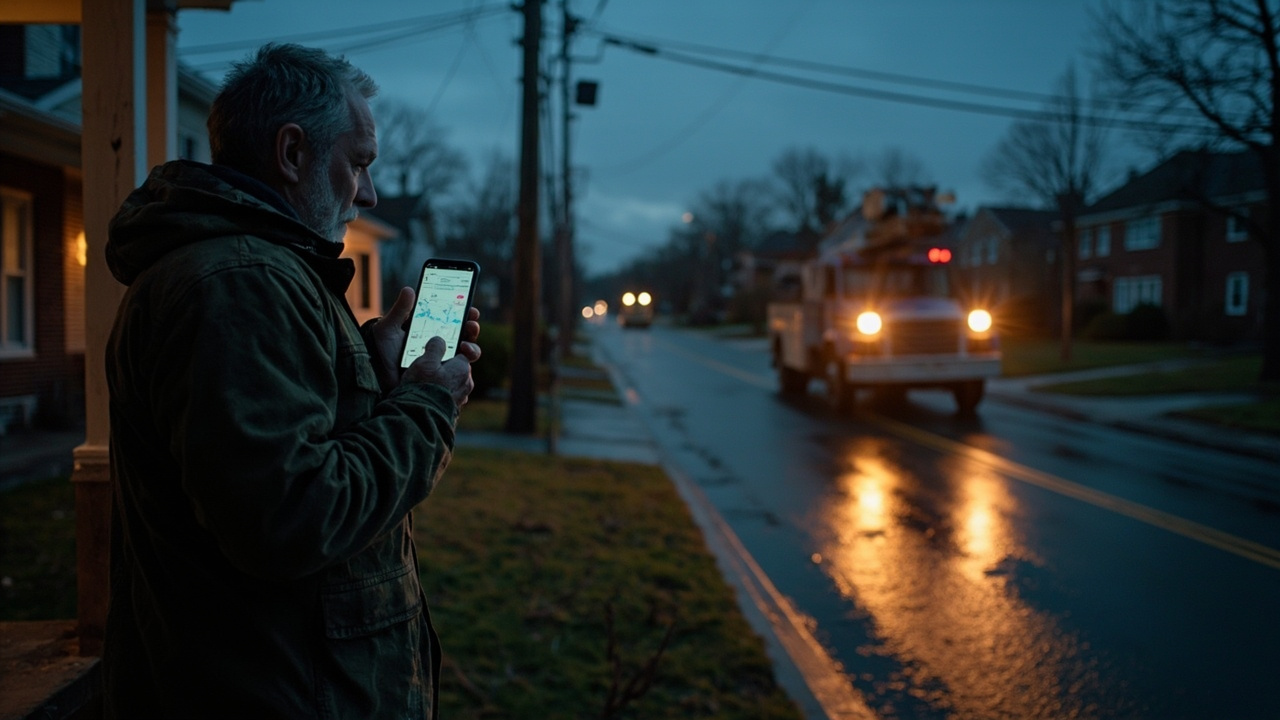
TL;DR: DTE Energy's Outage Center listed 2,676 customers as interrupted and 99.88% of its electric service area with power in its 11 p.m. Nov. 26, 2026 status update, the utility's latest service-area count as a Thanksgiving storm system brought rain and gusty wind to Southeast Michigan.
The dashboard snapshot
The public status page at outage.dteenergy.com covers a territory where DTE supplies 2.3 million electric customers, according to the company. Its service-area panel, stamped Nov. 26 at 11 p.m., counted 2,285,042 customers with power against 2,676 interrupted. The same page bundles the four things a household needs during an event: an outage report, a status lookup, update preferences and the outage map. Streetlight problems have a separate reporting path on the page.
DTE had prepared for the holiday system in advance. A Nov. 25 company release said 350 lineworkers were on call, with showers starting late Thanksgiving morning, heavy rain possible from 4 p.m. to midnight, about an inch of rain and gusts of 30 to 40 mph, with isolated gusts to 45 mph. Brian Calka, a senior vice president at DTE, said the crews were ready "if the weather turns tomorrow."
The National Weather Service office in Detroit/Pontiac issued a forecast discussion at 7:03 p.m. EST on Nov. 26 that called for northeast gusts of 30 to 40 mph that night, strongest near the shorelines, rainfall of 0.75 inch west of I-75 to 1.25 inches across far eastern Michigan, and wet snow possibly mixing in before Friday. It also noted another round of light rain likely on Sunday.
Report the address, not just the outage
DTE's outage FAQ warns customers not to assume the company already knows. Equipment on the lines can mark areas that have lost power, but a customer report identifies the specific site and helps dispatchers send crews efficiently. Reports can be filed in the Outage Center with a service address or the phone number on the account, through the DTE app, or on the automated line at 800-477-4747, which also returns a restoration estimate.
Alerts can be set for email, text or both under My Profile and Preferences, then Notification Settings. If an alert arrives while power is on, DTE may ask for confirmation or may need no reply. The outage map searches by address, ZIP code or county, which lets a traveler check a home from another state. Partial trouble counts as a reportable event: the FAQ asks customers whose lights flicker, dim or shine unusually bright, or whose power is out in only some rooms, to file a report and describe the symptoms.
The FAQ also marks two categories as not DTE's responsibility: electrical problems that originate inside a home or business, and internet, cable or landline trouble that may come from another utility.
Why the restoration estimate takes hours
Severe weather forces a delay before any clock starts. DTE says assessment can consume several hours, because damage must be measured and a restoration plan built before schedules are issued. The FAQ lists the inputs behind each estimate: the scale of damage to utility infrastructure, including downed lines, broken poles and fallen trees; the crews available, including line workers from other utilities in and outside Michigan; and the number of customers affected.
The restoration sequence explains why one street waits while another lights up. Crews clear hazards such as downed lines first, then critical facilities — hospitals, nursing-care sites, police and fire stations, broadcast radio and television stations and sanitary pumping stations — then substation equipment that feeds whole communities, then circuits for large subdivisions and businesses, then equipment for individual homes.
The safety rules that do not change
Storm guidance from DTE does not shift with the forecast. People should keep at least 25 feet between themselves and any fallen line, and from anything the line touches, and should treat every wire as energized. Yellow caution tape marks a boundary not to be crossed, children and pets stay indoors until wires are cleared, and emergencies go to 911. A suspected gas leak has its own order on the Outage Center: get out of the area, call 911 from safety, then call the gas leak hotline at 800-947-5000. DTE also supplies natural gas to 1.4 million customers across Michigan.
Generator numbers worth setting before the next front
DTE's portable generator guide separates two figures that decide whether a unit works. Constant wattage is the draw from everything meant to run at once. Start-up wattage is larger, since motor-driven loads such as furnace blowers, freezers, refrigerators and air conditioners can require up to three times their running wattage to begin. A generator should meet the constant load and carry a surge rating at or above the start-up load.
The guide flags backfeed — current pushed backward into utility lines — as a hazard that can injure or kill line crews and neighbors. The recommended fix is a transfer switch installed by a qualified electrician; without one, appliances should plug directly into the generator with main breakers switched off. Generators run outdoors only, away from windows and doors, never inside a home, garage or other enclosed building, and they get shut down before refueling. Appliances start disconnected and come on one at a time.
What the 2029 reliability target means
DTE's grid program has two stated goals: fewer outages and shorter ones. The utility's Power Improvements Map states a commitment to cut outages by 30% and cut outage time in half by the end of 2029, supported by $9 billion of investment through that year. DTE has said it would rebuild significant parts of the grid and automate it with smart devices. The map displays work planned for the next two years and completed in the previous three, and ZIP-code averages show time with and without power for 2023, 2024 and 2025.
What to do with the next update
Read the timestamp before trusting a number: the service-area panel publishes one, and the count is a moment in time rather than a forecast. Report the address rather than waiting, set alerts so a text arrives when the estimate changes, and keep the 25-foot rule and the generator placement rules settled before the next front arrives. DTE's page remains the live record; the figure at the top of this story reflects its 11 p.m. Nov. 26 panel.